Showing posts with label Point 'n' Click. Show all posts

Wednesday, 23 January 2013

Why You Should Play Virtue's Last Reward

This review and eulogy for my game save was originally posted on n-Europe, and can be found here.

Virtue's Last Reward is outstandingly fresh, gripping and challenging. It's by far the most interesting 3DS game I've played. But you shouldn't buy it; at least, not yet.

To explain why you shouldn't buy it is relatively simple, but explaining why the game is so good is more involved – and involves a small history lesson. So without further ado:

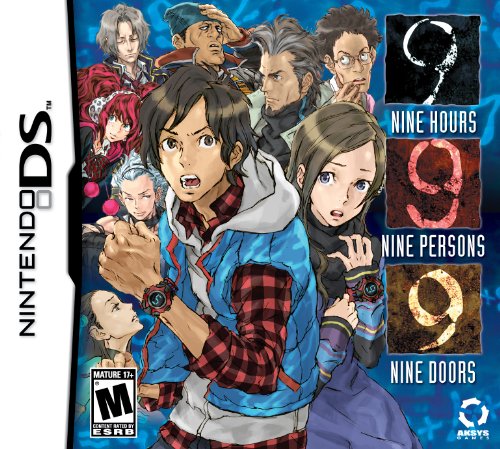
Once upon a time there was a company called Chunsoft. They produced a game in 2009 called 999: Nine Hours, Nine persons, Nine Doors for the DS, and it was incredible (see my personal review). While the Visual Novel genre was (and still is) a staple in Japan, the closest many western consumers got in the genre was the Ace Attorney series.

999 offered a suspenseful and harrowing plot; nine people find themselves trapped on a sinking ship and tasked with playing the 'Nonary Game'. The road to escape is filled with puzzle rooms, odd discussions about metaphysics, and the occasional spot of chilling gore. Even though 999 never saw a release in Europe, the title proved to be popular enough for a sequel to be made: Virtue's Last Reward.

In 2010, a separate games studio called Spike released their own Visual Novel for the PSP: Dangan Ronpa. It had a distinct, yet similar theme to 999; A murder mystery involving 15 students trapped in a high school of despair, headmastered by a psychopathic talking teddy bear, Monobear. The title was only ever released in Japan, and was an unknown in the West, until the game was covered as a 'Let's Play', translated into English by Orenronen, a member of the Something Awful message boards.

In early 2012 Spike and Chunsoft had a merger into, er, Spike Chunsoft. They had been owned by the same conglomerate as far back as 2005, but this merger seemed apt; Virtue's Last Reward takes on many thematic elements from 999 and Dangan Ronpa. It has an outstanding pedigree, and it shows.


You play as Sigma, a seemingly ordinary university student who, on December 25th of 2028, finds himself suddenly kidnapped and trapped within a giant warehouse with 8 others. The reason? To play the Nonary Game: Ambidex Edition. Escape will only be granted to those who can successfully amass 9 Points, gained by allying with fellow players... or betraying them.

As with its prequel, Virtue's Last Reward is incredibly verbose, but offsets its novel sections with 'escape the room' puzzles. However, this time everything has been kicked up a notch. There are so many possible branching paths to the plot, a function to jump between checkpoints in the game was mercifully added. Puzzle rooms have bonus challenges that give secret files. They explain the game's backstory, in a... disarmingly casual fashion. Getting these bonus rewards requires some lateral thinking, and are definitely rewarding to solve.

Alice from Virtue's Last RewardThe characters are also a joy to get to know. The character designs have a mixture of hits and misses (the character artist, Kinu Nishimura, often adds fanservice to her art, and some of VLR's characters get more than their fair share (as seen to the left); but all of them grow over the course of the game, some in unexpected ways. The voice acting for the European version is Japanese-only (the NA release had an optional English dub), but they all suit the characters well; especially the evil AI that hosts the Nonary Game, Zero III (his inclusion is very similar to that of Monobear in Dangan Ronpa).

The challenging puzzles and compelling plot had me playing every night; staying up until ridiculous hours finding my way out of a locked pantry and deciding whether or not to betray my team mates on this play through. But as I progressed, cracks began to appear in VLR's veneer.

At first they were silly, easily ignored things. The localisation of the text often strays from what's said in Japanese, and noticing when the two don't match up is a little jarring. During puzzles, the framerate stutters when you rotate the camera. The script insists on writing 'donno' instead of 'dunno', along with a number of silly typos in general.

And then there were the save corruption issues.

It was a problem known about in the American 3DS release. There was a bug that could corrupt your save file if you saved in the middle of certain puzzle rooms. This was annoying, but easily avoided. After the EU release, that warning was extended to all puzzle rooms. This was considerably more concerning; but still avoidable.

But then, after around 20 hours of playtime, I decided to take a break. I was nowhere near a puzzle room, so I felt I was safe. Not so. When I next boot up my game and try to load my save, I was greeted with a black screen. My 3DS had crashed. Two-thirds of the way through a great game, and my journey was over.

It brought about an odd feeling inside me. I had pre-ordered and happily laid down my £30 to play a game that would unlikely see Europe's shores. The game was engrossing and compelling enough to lose many, many hours of sleep. I would have given the European publishers, Rising Star Games, money up front if it guaranteed games like this to be consistently released over here. But at the end of the day, I had paid £30 for a game that didn't work.

I'm still not sure how to make peace with that. At time of writing, Rising Star Games have gone on record to say that they are aware of the problem; but nothing regarding what they're going to do about it. 3DS games can be patched (It happened with Mario Kart 7 not too long ago); but who knows if the same will happen here. Until some concrete action has been taken, please hold off on enjoying Virtue's Last Reward. Getting obscure releases is wonderful; but only if they actually work as intended.

Wednesday, 12 September 2012

A Future of Polygonal Friends: Final Comments

This piece is split into three parts (Part 1 is here, Part 2 is here), and was written for the Critical Distance Blogs of the Round Table. 

Thanks for taking the time to read 'A Future of Polygonal Friends'!
 
This was actually an idea I'd had for a long long time, inspired by an article I read in EDGE magazine, talking about AI in games. My initial angle was actually to talk about how we can design better and more empathic NPCs on the whole, but when I saw Critical Distance's Blogs of the Round Table request ('Blogger Jam' would be a way better title, no need to thank me), I set out to take my article concept out of the realm of Notepad musings, and into a properly published format.

And wow. This essay is way too long, hardly ideal for putting on the web. But I felt that to explore the idea in a way that doesn't make people frantically sprint after my own leaps in logic, the first half was necessary. Plus, since this is written with other media bloggers in mind, hopefully those that stumble across this will make it to the end (clearly you have, or you wouldn't be reading this!)

Honestly, I struggled a little reworking this to fit the theme in a way I felt was complete. Writing about AI and good storytelling are both simple enough, but how do you link the two without sounding like an idiot, vague, or a vague idiot? Then I realised the potential was in AI characters telling their own story separate to that of the protagonist's, intersecting when and where the player wants, and there being consequences for those decisions. Story telling and character design need not act at odds to developing AI, but can work with it.

Forgive the large number of Non-AI examples used in the first half; I feel like examples of good design and dialogue without an emphasis on AI would be an important contrast to AI-based solutions. I won't apologise for making fun of Tropers, Power Ranger fans and Katawa Shoujo fans though; y'all are just asking for it.

Wednesday, 23 March 2011

Death Count - 9 Hours, 9 Persons, 9 Doors

 
The genres for video games are vast. Most are aware of First Person Shooters. Real Time Strategy is less common but hardly unheard of. But then there's the Visual Novel; a genre only really paid attention to by a much more marginalised audience. They are what the name suggests - games that are interactive books - focusing on the story depth and characters rather than action sequences.
 
Games of this type vary in quality; the Ace Attorney series is the best example released in the West, but Japan has its own special sub-genre of risqué Visual Novels that creep me out.

9 Hours, 9 Persons, 9 Doors (herein referred to as 999 for my sanity) is very much its own beast. An easy way to describe it would be "The cast of Ace Attorney in a Saw film", but that doesn't quite do it justice. You play through the eyes of Junpei - a teenager who has woken up in an abandoned bedroom on a ship. The only thing in his possession is an irremovable metal bracelet with a '5' on it. Then inexplicably, the room starts to flood with water, and Junpei must find a way to unlock the door, or die trying. He finds that he and eight others are playing the 'Nonary Game', where success means escape, failure means drowning, and breaking the rules means a bomb in your stomach going off.

The game's puzzles all function similarly, each room you enter contains a set of puzzles resulting in an escape route unlocking. None of the tasks are straightforward, but they're all based in sensible leaps of logic, solved with patient thinking. So while there is a sense of atmosphere and tension in solving the puzzles (though there's no time limit), it's not frustrating - a lesson that the Professor Layton series could learn from.

With the puzzle sections so short, the bulk of 999 is instead taken up with narrative; and damn is there a lot of it. There can be hours worth of dialogue in between each interactive element, sometimes even within the room escape sections. This would be unbearable under most circumstances, but the story is strangely compelling. Of course, it doesn't exactly stand up to a quality ink-and-paper novel, but the subject matter and quality of the translation from Japanese is impressive. While there is no on-screen gore, descriptions of violence and of any 'rule breakers' you come across are done creepily well.


The character depth is what made the game for me. While the room puzzles are enjoyable, they're brief. This game survives entirely on the strength of its narrative; so thank goodness it's such a good one. In the early stages of the story, the characters feel like numbered narrative devices, but as you progress, all the characters become fleshed-out and empathetic; you'll definitely find a favourite. This is coupled with a quality soundtrack done by Shinji Hosoe, previously known for the high-octane techno tracks he creates; this is first foray into ambient and atmospheric tunes, and it works incredibly well.

999 has multiple endings, depending on which puzzle rooms you decide to tackle. Each ending explains more about the characters and nature of the Nonary Game, so repeat plays are necessary to understand everything. On subsequent runs, you're able to fast-forward through text that you've already seen; which makes the process much quicker - sitting through some of the longer cut scenes again would be maddening.

999 rewards the open-minded gamer. A game consisting of 'pulp novel' dialogue will be a huge turn-off for some, but the execution is so well done, I implore the adventurous to check it out. Be prepared to use an importing website, though - while the American release has been available for a few months, there is no sign of an EU release as of yet.

This review has also been hosted on The Yorker and can be found here.

Tuesday, 22 February 2011

So Now, You're a Crossing Gate: Ghost Trick


When video games as a general rule have the player character avoiding death (or inflicting it); it's an unusual thing when a game starts with the Player Character dead from the get-go. You play as Sissel, a reawakened amnesiac spirit in a junkyard accompanied by only a red-suited corpse, a female detective with a bizarre hairdo, and a blue-skinned assassin in a suit, hefting a large golden shotgun. The detective seems to know something about how and why you died, but meets an untimely death. Fortunately you gain the power of the 'Ghost Trick'; the ability to possess and manipulate small objects, and the ability to rewind time to the 4 minutes before someone else's death. If you can save the detective, maybe you'll get some clues about your past...
 
Ghost Trick was directed by Shu Takumi, the same director behind the Ace Attorney series, and by God that legacy shines through in this work. That series was packed to the brim with over-the-top memorable characters, great storytelling, and an episodic feel that made it easy to pick-up and play. These design philosophies have been expertly transported into Ghost Trick; Sissel's musings are sarcastic and likeable, Detective Lynne is still worth rescuing every time she meets her end (even after the gunman in the junkyard, she has troubles staying alive), and storyline chapters are just the right length for you to finish one on the train, or before you go to bed.

However, the Ace Attorney series has stagnated over time. The initial three DS releases are actually re-released Japanese-only Game Boy Advance games - and replaying them now, the age shows a little. The more recent games rely mostly on the success of - and cameos from - the previous instalments; and while I am pretty damn excited for Ace Attorney Investigations 2, it won't offer anything in the way of a fresh experience. Ghost Trick is that breath of fresh air, both in terms of how it looks and how it plays.

Game play reminds me of a Rube Goldberg Machine. When rewinding someone's death, you have to manipulate items scattered around the room to alter the path of those in peril. A victim can't hear the assassin approaching due her headphones? Knock them into the nearby fish tank. Large wrecking ball suspended by a fragile clamp? Get the clamp to open, and watch havoc unfold. If you spend too long, or accidentally put the victim in even more danger, you can go back to the start of the 4 minutes at any time, with no penalty. The puzzles are logical and encourage you to tinker around with the pieces for happy successes, and the occasional hilarious failure.

The style of the game is also extremely noteworthy. Where Ace Attorney mostly used mugshots and still images to tell its story, Ghost Trick is an animated wonder. Stylised 3D models waltz across the 2D set with a whole lot of energy and flair. For character Detective Cabanela, just walking downstairs or answering the phone can be turned into a performance. The design of the locations has the gritty Film Noir aesthetic, but rendered in bold colours and anachronistic technology. The same goes for the funky soundtrack - mysterious grooves with an electronic flair.

The story is a gripping one, but it's filled with so many twists, I'd feel bad for sharing it and spoiling the experience. The ending is open enough to have a sequel if Capcom wants more money; and in a way they're fully justified. Ghost Trick is a total gem of a game, and is one of the best Story-Driven puzzlers on the DS to date. And that's no Trick.

A demo of Ghost Trick can be played for free online here! Awesome!


 This article has been hosted on The Yorker, and can be found here.

Tuesday, 6 July 2010

Article Catchup: York Vision Issue 205

Now that I'd managed to get an entire page published on my own, it was time to step up my game. Issue 204 looked good (at least to me), but there were flaws. Although the page looked good on the screen, a lot of the images came out blurry and at a low resolution. The circuit board background was light enough to have the text above it readable, but it could still have done with tweaking.

I took these flaws on board, and corrected them with Issue 205. As a result, this one is probably my favourite in terms of layout. With the old format established by the previous Editor kicked to the curb, I was free to go for column articles, and features of varying lengths. The banner and background adapted to a different colour completely flawlessly. Changing the colours cheme was as easy as cake, and made the page look brand new each time.

This issue was to feature a guest writer, and has since been the only issue to do so. His original request was to do a review (Bioshock 2) which would have been an incredible help; I didn't have easy access to an Xbox 360 or a PS3 at the time, so he could appeal to an audience I could not. However, it turned out that he canceled on this idea at the last moment, and instead submitted AtmosFEAR. The article was fine (if wordy); but it left me in a hard-pressed position to come up with a review.

Therefore, the Ace Attourney Investigations review didn't arrive in best condition, and actually made print with a few bad typos still intact. It was all horribly embrassing.

The Co-Op gaming article was much better. The 5 games were thought up between me and the (mostly) lovely members of The Spriters Resource Community. Playing with a friend is quite possibly the greatest joy in gaming for me, and this article reflected that.