Showing posts with label Game Design. Show all posts

Wednesday, 4 September 2013

Express Yourself: Being a Fashionista in the Gaming World

 This feature is also available at n-Europe, found here.

Self-expression is an inherent part of almost all video games. By simply being a medium where the audience can interact with the work, they're allowed to make an impact within the game. Even doing nothing at all is technically an expression.

But that viewpoint is pretty pretentious and nebulous. In a practical sense games have two ways most people consider outlets for expression - building environments and player customisation. There are deviations of course, but what you come across in mainstream titles will boil down to one of those two.

To be hyperbolic, building (or destroying) environments doesn't give me much joy. I know there are plenty of people who spend countless hours crafting the perfect urban environment in SimCity or constructing a golden, penis-shaped fortress in Minecraft, but it's not my thing.

What I can burn hours on is thorough character customisation - perfect for my egoistic nature. Most games are very mechanical about this (will you put points into attack, defence or custard pie resistance?), but the real draw is the fashionable side.

It's the perfect way of showing how painfully unique and stylish I am. I have an avid interest in fashion and subculture - though since the general demographic target for mainstream games  is not... shall we say 'particularly sartorial', games that let you choose your fashion choices stand out as special.

It's all well and good to have a robust character building system in a game, but if it's all impossible fantasy armour or tattered brown military gear then *snore* - let me wow crowds with sharp suits and bold patterns.

Monster Hunter butterfly suit
Which, coincidentally, had me all kinds of hyped for New Style Boutique earlier this year. I had much enjoyed the original DS game (to the raised eyebrows of almost all my male peers), and having my fashion tastes not only fully expressed but at the gameplay forefront seemed like a dream.
Funnily enough, it didn't fully meet up to my expectations.

New Style Boutique is a fun and well-produced game, don't get me wrong. But, in order to give something as subjective as fashion tastes win and lose states, the game has a hidden set of rules for  what works and what doesn't.

It's surprisingly restricted. For example, I personally hate wearing too many things from the same brand at once (it makes you look like a walking billboard). But because each brand in the game is dedicated to a single 'look', hardcore brand loyalty is the stairway to success.

I had to form an uneasy balance between experimentation and ticking all the invisible boxes the game required. This wasn't punk in the slightest, no matter how much Stage Dive-brand clothing I wore.
Where I found a far better style experience on the 3DS was, surprisingly, Monster Hunter 3 Ultimate. Now, MH3U has more than its fair share of overly-bulky, ridiculous armour sets, but it's sprinkled with some real flair.

Every enemy you fight in the game can be turned into items to wear, and it takes a few kills before you have enough materials to make the full suit. This has the great side-effect of making you work hard for your fashion. When I first started playing, and found I could wear a suit and top hat made from butterfly wings, I was totally blown away.

But the bugs that the suit was made from were delicate, and shattered into dust against my weapon, denying me a carving opportunity. Working out how to reliably get the carves (the trick is to poison them) and gather all the parts took me hours. But the result was pure joy and a fabulous, lustrous sheen.

Even though the different armours are tied to mechanical benefits (each armour set gives a bunch of skill bonuses) crafting an outfit that both looks cool and gives skills you want is a test in lateral thinking.
 
Animal CrossingHowever, my customisation ideal is the ability to design clothes myself. It's not an impossible task (the Sims modding community has been doing it for years), but the Animal Crossing series makes it breathtakingly easy.

The simple, low-poly style of the game means making patterns is a painless process. Spending years of my teenage life doing (mediocre) pixel art as a hobby meant I could go to the Able Sisters tailoring shop and churn out clothing like a Primark sweatshop.

Animal Crossing New Leaf takes the extra step and allows design of clothes of three different styles - as well as making trousers and shoes separate items, so you can create an ensemble from top to toe.
July can't come fast enough. Look out for Nathan Blades Summer 2013 clothing range in an Animal Crossing town near you.

Serial Gaming: Fighting Games

This article can also be found on One Hit Pixel, here.

I’ve loved fighting games for a long time. I’ve never been great at them – most of the time I’m not even good at them – but they bring about such excitement and tension. The kind of hollering at the screen you can only manage when it’s about a toe-to-toe duel with larger than life attacks. I’m an ardent pacifist in real life, but in King of Fighters, I’ll stain my hands with your blood.

That said, until very recently, I didn’t quite appreciate how games within the genre have such important differences. At the moment I’m playing Persona 4 Arena, Skullgirls, and Tekken Tag Tournament 2; but I admit that I approach them all mentally in a rather similar fashion.

At their core, all fighting games (the good ones, anyway) follow some basic tenets: movement and spacing, the attack/block/throw strategic triangle, and even how the HUD should look. The other differences feel aesthetic, maybe even inconsequential.

Then I discovered Salty Bet.

Serial Gaming: Fighting Games
13:1 odds for Chun-Li
For the uninitiated, Salty Bet is a perpetually running stream of MUGEN, an open-source fighting game engine where users can create characters. Fighters from the history of the genre, popular or obscure, have been rendered in the engine, along with bizarre and imbalanced custom creations.

Characters are selected out of a roster of hundreds, and fight it out while controlled by AI. Viewers gamble on the results with play money, with the payouts depending on which way people have voted.
It’s a rather dystopian form of entertainment, but it very quickly becomes inexplicably compelling to watch. For fighting game enthusiasts, it’s a nostalgic mash-up of favourite characters, obscure series, and bizarre custom creations.

I witnessed a rather tense match between Clark Steel from King of Fighters (A burly military man with a penchant for wrestling) against Robo-Ky from Guilty Gear (A surprisingly sassy robot filled with missiles).

The ground-based combo heavy system of King of Fighters was an odd match against the high-speed aerial manoeuvres of Guilty Gear. It was a tense match, and not just because I went all-in on Robo-Ky. Sadly though, Clark won out.

When universes collide
In the same way that taking the Blue Falcon for a spin around Mario Circuit sounds like a fun idea, but logistically silly – Salty Bet makes it clear that the minutiae that sets games in a genre apart are differences worth respecting.

The problem is, crossovers between series are the dreams of obsessive neckbeards the world over. In the same way that superhero comic fans lust for a fight between say, Captain America and Superman, fighting game fans can’t turn down a fight between Ryu and Kyo Kusanagi.

Official crossovers of that nature do indeed exist, with Capcom vs SNK 2 and Street Fighter x Tekken being the most famous examples. However, in both games, the attempt to bring disparate fighting systems together was a tricky process.

CvS2 actually takes about 8 different fighting game series from the two publishers, and takes at least one mechanic from them all! A ‘groove’ type you select at the start of each battle determines what gameplay style you use. It was a good game (and the game where I first tried to learn how to play instead of just mashing buttons), but the complexity resulted in matches playing out similar to those bizarre 3D chess sets while simultaneously trying to land an aeroplane. That’s caught fire.

SFxT went a slightly different route to blend its host series. Making a 3D fighting (and largely projectile-free) system like Tekken work in a Street Fighter format is an obvious conundrum, but mostly the game uses entirely original mechanics, including the ‘Pandora Mode’ desperation move and the infamous Gem System. The resulting experience felt gimmicky and awkward. While the Gems provided handicaps for less skilled players, their use didn’t help said players understand the quirks of the game any better.

The Birth of New Series
Because CvS2 is so inaccessible, and SFxT was largely a hot mess, it’s difficult to call those crossover games a total success – but experiments like those titles have definitely formed the latest generation of fighting games.

Since we’re no longer in an era where Street Fighter is the genre baseline, new fighting games don’t need to intentionally come up with new mechanics to set themselves apart – we have a complex library of games systems, ripe for remixing into something new.

Skullgirls, which has recently become available on Steam, is a prime example. Although it doesn’t look like it on the surface, the game is packed to the brim with bits and pieces from other fighter series the developers had close to their hearts.

However, because it’s not overtly trying to mash different games together, the experience as a whole is very unified and smooth. It’s been described as the missing link between Marvel vs Capcom 2 and Guilty Gear, and I can definitely feel that when I play.

Yatagarasu is another indie fighter that only very recently completed a crowdsourced fundraiser to become a more robust, multi-platform release. Its lead developer was heavily involved with the development of several King of Fighters titles, but it aims to be something far beyond that. Most notably, it features an easy-to-use parry system (which most famously showed up in Street Fighter III) for some very technical battles.

As a final, kind of silly example, did you know that there’s a League of Legends fighting game in development? It’s fan made, but it’s been given the all-clear by Riot. Because they want it to be accessible to players who aren’t used the execution requirements of fighting games, they’re actually taking cues from Super Smash Bros. for how special moves work. I wait for more information about it with apprehensive curiosity.

Serial Gaming: Animal Crossing

 This feature can also be found on One Hit Pixel, here.

When I committed myself to writing a set of features on my opinions of gaming series, it looked like a cakewalk. But after some thought, I found it needed a more tentative approach. You see, I’d like to say that I am ardently opposed to ‘sequelitis’. In my mind, the greatest gaming achievements are rarely held by sequels (sales figures notwithstanding). Ideally, I would want to say that I don’t have a favourite series, followed by many words about the indie gaming scene.

Sadly, that’s not true at all. I’ll hold my hands up and say that there are a few series where I’ve played most, if not all of. Today, I’ll talk about one that’s not my absolute favourite, but one I’ve recently clocked as having some genius game design I didn’t appreciate way back when.

Serial Gaming: Animal Crossing
Animal Crossing is not a series I’ve followed from the start – my first foray was Animal Crossing: Wild World on the DS – but every game since then I’ve sunk countless hours into.

In my high school years, Wild World had me completely enthralled with its miniature idealistic world. However, I wasn’t a genius authority on game design back then – I took the game experience entirely at face value. It’s difficult to give an honest answer as to why it clicked with me so well.

The best I can manage is a reference to the Skinner Box theory. Animal Crossing keeps you coming back every day with the prospect of something new – fossils that your museum might not have yet, another item of furniture for the themed set you’re collecting, or that fabled Coelacanth. To a kid raised on Pokémon Trading Cards, that kind of game design is like digital cocaine.

I befriended villagers to get their photo items. I expanded my house so I could better show off the rare furniture pieces I procured to my classmates who also played. What AI and design work that went on behind the scenes went unappreciated.

Serial Gaming: Animal Crossing
Years later, the Wii semi-sequel, Animal Crossing: City Folk came out. On paper, it was the kind of content expansion I could have ever wanted. By that time I was in sixth-form, older and more jaded about my gaming habits.

I no longer had a raw, completionist instinct. I could carry over my character from Wild World, but I wasn’t motivated to play every day any more. The game had more robust content, but I was looking for story-driven experiences in that time of my life. I still played, but I was failing to ‘get’ what Animal Crossing did best. Eventually I lost a couple of hours progress to an internet connection drop and I set the game aside for good.

So then, fast forward to this year. Animal Crossing: New Leaf had me excited, but I couldn’t have explained to you why. Just two or three days of play later, the pieces clicked into place, and it dawned on me what was so special about the series.

In no other game does the player’s creative input have such a direct payoff. Every choice made available – how you arrange your town, how you decorate your house, what you wear – can be shown to and enjoyed by other people. It’s been present across all of the games (even in the Gamecube and Japanese only Nintendo 64 games, where you are encouraged to have everyone in the household play), but New Leaf goes leaps and bounds into make both creating and sharing content as easy as possible.

The most salient example is with pattern designs. In all the games you could make designs for clothing or house furnishing. With New Leaf, not only are the uses for your patterns pretty broad, you can turn it into a QR code and share it with other players. I’ve been designing patterns of my own, and it’s the best feeling ever when some sends you a picture of them wearing something you’ve designed.

Serial Gaming: Animal Crossing
New Leaf‘s heavily pushed feature of being the mayor of your town feels like a gimmick at first glance, but it means that your town is now like your patterns – customisable, and can be shared with your friends. More so than the randomised town layout every player starts with, what kind of public works you build makes your town truly unique.

There are other games that run a theme of sharing customisations (It’s the only way I can fathom people playing Minecraft), but I’ve not found any others that makes the process so simple yet so immediately rewarding. You can bask in the satisfaction of your town not only looking good, but everyone else you know with the came can see for themselves how sweet it is.

Ah, but there’s another trick up the game’s sleeve. Even though creating content is hassle-free, it doesn’t give you all this customisation up front. For example, you can’t get the ability to share pattern QR codes until you properly befriend the hedgehog sisters that run the clothing store – which could take around 10 days from starting the game!

Getting new furniture is a slow process unless you talk to the other residents and help them with errands. Anyone who plays Animal Crossing knows to set aside 10 minutes every Saturday night to score some new bootleg songs from a guitar-playing dog (on a side note, never try to explain this to your friends unless you want to be labelled unhinged).

You find that when you’re engaging the game world so you can make creative and completion progress, you form a kinship with the characters you encounter. You don’t need to have a favourite town resident to be able to expand your house, but every player has one.

It was a side of the overall gameplay that I didn’t fully appreciate as a kid (I made maybe eight patterns in the two or three years I played Wild World). Animal Crossing each instalment of the series to further blur the lines of getting immersed in the game and letting you explore your creativity through the game, but the present results blow me away.

If there is to be a Wii U incarnation (and that’s rather likely), if they integrate the sharing of content to the Miiverse and allow cross-platform play with the 3DS, it would be all that easier to reach some stranger on the other side of the world with a little bit of my self-expression.

Oh, and as a side note, go read through Dave Irwin’s Animal Crossing: New Leaf diary if you haven’t already.

Wednesday, 23 January 2013

The Solution is Fisticuffs

This feature is also available at n-Europe, found here.

The Menu-Based RPG. Iconic for the games that come under it, the way it changed perspectives on game design, and the impact it had on gaming culture. It's also a genre that's fallen almost entirely out of favour with the present gaming scene; all due to two common design features.

The first is grinding, a concept that - if you're reading this - is most likely known to you. The process of doing a task over and over until you're in the condition to progress. It could appear in subtle fashions, but because grinding can lengthen a 10 hour game into 20 hours, the games of old used it to make the title worth the high sale price, and the games of today use it to keep you firmly glued to your screen.

The second is something I call 'Stats as Progression'. It's something also familiar to RPG players, but it's less commonly discussed. Since the classic definition of the RPG is based around concepts of pen and paper games like Dungeons & Dragons, RPG characters have their abilities quantified. I'm talking about Health Points, Defence, Agility... Let's just call them your 'Numbers'. As a shorthand for your character growing stronger, these Numbers increase as you fight and win battles. The player can feel as though progress is being made, but in games without an action element, they can remove 'agency' from the player a little. It's frustrating to have an attack miss, just because a hidden calculation dictates so.

Final Fantasy
Combine these two ideas in one game, and you have a system where progression through the game is dictated by how high your Numbers are. And to get your Numbers to a level where progression is possible, you need to grind – most likely through killing enemies. But if this was just a flat proportion of Numbers Required to Time Playing, the game wouldn't feel like it's increasing in difficulty. So to combat this, the time grinding to get to the target Numbers gets progressively longer.

Does this sound like a game you've played before? I'm sure you can name a few. The thing is, when that's all that there is to a game's progression, the only aspect of a player that's being challenged is their patience. In an action-oriented game, to progress requires a steady increase in skill. Here, the player's skill need never improve.

Honestly, it's the number one reason why I, personally, will stop playing a game. Grinding is not fun by itself, and if the process isn't made engaging, or the reward doesn't feel worth the effort, then it's time to move on to greener pastures.

To avoid a game where winning is simply a matter of having the biggest Numbers, game designers need to look at what exactly their barriers to progress are, and how they can give the players more agency. It's almost like... a puzzle.

Puzzling Punch-Ups Performed on Paper

Paper Mario: The Thousand Year Door is my favourite title on the GameCube. Its aesthetics were top-notch and would be enough for me to love the game alone, but it was the gameplay that sold me. PM:TTYD turned combat into a performance, figuratively and literally. To defeat enemies by just selecting your strongest attack was inefficient, and in some cases outright impossible – success came to those who mastered the infamous 'timed hits'.

And it wasn't just about attack execution – many enemies were designed with a puzzle-solving element. Beyond Mario's skill-set of stomps and hammers, he gets an entourage of partners who each have their own special skills. Koops the Koopa Troopa is immune to damage from spikes. Vivian the Shadow Siren can pull Mario into the ground, avoiding attacks that would otherwise be unblockable. As your partners are introduced to you, the fights get more demanding, requiring you to use your new abilities effectively.

To have battles be 'perfect' puzzles, the abilities of the player have to be known at all times. This can be a hard thing to incorporate into the normal RPG style. While this works for Zelda games, where access to every weapon is carefully timed with what dungeons and bosses you'll be fighting; imagine if Pokémon limited the monsters available to you for Gym battles! It would definitely be more challenging, but a lot more restrictive.

Examples off the Beaten Path

Puzzle QuestSome titles get around this by making the method of combat puzzle-like, rather than detailed strategies to defeat specific enemies. Puzzle Quest immediately comes to mind (though I find it a bad example, as the computer tends to cheat), but if you take a dip into the esoteric there are some good examples.

The 2009 DS title Radiant Historia was, in many respects, generic. The setting, characters and writing were entirely uninteresting (at times painfully so). However, it had a fascinating battle system. Enemies you fight hang out on a 3x3 grid, and can be repositioned by your party's attacks. Consecutive attacks will chain together, so with some careful planning you can force all foes onto the same panel, taking heavy damage with every attack.

Baten Kaitos was a beautifully weird GameCube game that featured cards as your means of attack. While each card had its own ability, they also came marked with a number; creating 'chains' of cards with incrementing numbers was vital to dealing good damage. As such, building your deck of attacks was a very involved and careful process.
Final Fantasy XIII (forgive me for not using a Nintendo example) was heavily criticised for being linear, but that meant the game ensured that each fight would be a worthy challenge – and its battle system (which revolved around changing team tactics on the fly to keep up with fast and vicious enemy strategies) made for some of the most intense fights I've played in a main-series Final Fantasy.

The Paper Mario of the Present

With the release of Paper Mario Sticker Star, fans everywhere fiercely compared it to the lofty heights of Thousand Year Door. Unsurprisingly it doesn't hold up, but not because it's inherently bad... just different.

With the sticker gimmick that Sticker Star is based around, it takes the idea of battles being puzzles to extremes. The puzzles outside of battle have direct impact on your progress in battle, and vice-versa. For those who aren't familiar with the game, Mario's abilities are taken from an inventory of stickers. Solving puzzles in the field and attacking in battle uses the same resource, and stickers are single-use.

Paper Mario Sticker StarThis turns Sticker Star into a giant resource-management puzzle. Every battle forces you to decide between using your best skills now or later – but hoarding stickers results in dead weight. Running out will cost you time and money to replenish your stocks (so failure isn't crippling), but you're gently encouraged to collect any stickers you find – even if they appear useless.

This is all well and good on paper (har har), but for those expecting a more tried-and-true RPG experience, the different approach to battles has proven a little off-putting. Still, this shouldn't dissuade any Paper Mario sequels – or the Menu-Based RPG genre as a whole – from getting wild and experimental with their enemy slaying. 'Solving' a battle brings out a sense of satisfaction wholly different from sweeping digital vistas or satisfyingly chunky gun feedback.

In a gaming climate where the big-name RPGs are action-oriented, open world affairs; the Menu-Based RPG is slowly being forgotten. While no one will be too sad to see rigid, grind-heavy affairs fall by the wayside, there have been innovative puzzle-like experiences through the console generations. Who knows, maybe the next big RPG title of 2013 will challenge our minds in unforeseen ways.

A Professor Layton RPG, maybe? Hmm.

Tuesday, 30 October 2012

The Too Spooky Shopping Trip

This article has been written as part of the Critical Distance October Blogs of the Round Table. It can also be read at Digital Heaven Entertainment, here.

The scariest moment in gaming I've experienced? Accidentally saving over a near-endgame file of Final Fantasy Tactics Advance. I've not really played any horror games. Not because I don't want to, I've just never really gotten around to it.

Hopefully not having played the first 3 Silent Hills won't invalidate my opinions as a Person Wot Writes About Games; but until I eventually play them, there are a few times where a game has been successfully unsettling. The one that's still stuck with me is from Shin Megami Tensei: Strange Journey.

As a series, the Shin Megami Tensei games (this is excluding Persona and other spinoffs, mind) are very thematically similar. You, a lowly human have been gifted with the technology to summon demons to fight by your side, while a ridiculous catastrophic event goes on around you. Depending on how you react to certain story choices, you gain a Chaotic/Lawful alignment (intentionally not just 'good/evil', though often it pans out to be the same).

Where Strange Journey differs is its setting - a series of twisted worlds called the Schwarzwelt. Created by demons, it represents the ills of the human condition. You play as a soldier of a global army, investigating the Schwarzwelt in an attempt to destroy it; though you quickly find yourself unable to escape.

Welcome to Sector Carina

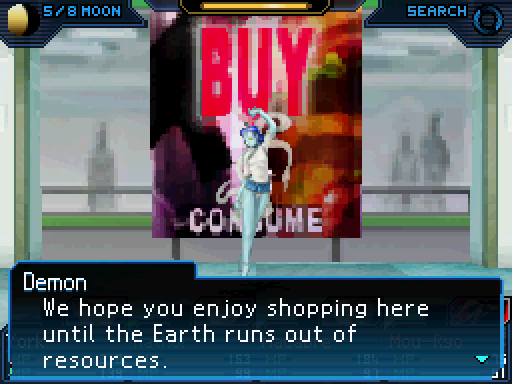
Up to a point, each location in the game plays up a problem with humanity, with a surreal twist. A lot of these areas don't have the impact they should (which I will discuss later), but the third area, Sector Carina is meant to represent humanity's greed, being a gigantic demon shopping mall.


And you know what? It really creeped me out. Sadly, not entirely due to the game's aesthetics, but at least partially! Sector Carina was clever in being uncanny. At first look, everything does look like an ordinary shopping mall (through the filter of low-quality textures on a DS screen), but then you talk to the first NPC:


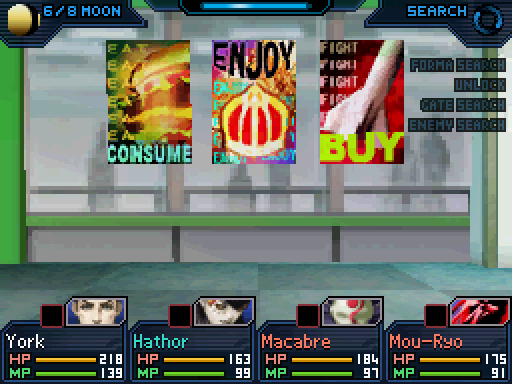
And then you look at the posters and the shop windows:


And then you pay attention to the slow, militaristic waltz used as background music:


And it settles in that this is a shopping mall with all of the pretence stripped away. Everything you could ever want is within these walls (along with a whole lot of stuff you don't), and your only company are towering urges to BUY, EAT, and CONSUME.

Relevance in a Riot

I was playing Strange Journey in August 2011, and reached Sector Carina during the time when the England Riots occurred. For those who aren't familiar, a riot broke out in Tottenham, a district of London, on the 7th of August. What had started out as a protest against police corruption and brutality in the area took a turn for the violent once someone decided to throw a bottle when the police arrived to suppress the protest. Things escalated quickly, with shops smashed and ransacked, and arson attempts. Once it started, similar riots sprang up all across London, and then into other, unrelated cities of England.


On the day they had started, I happened to already be in the centre of town, watching Croydon slowly go up in flames on BBC News. Had I not gone home when I did, the underground and bus services would have closed, leaving me stranded on Tottenham Court Road. I get home by sundown and find through Twitter that even my local high street had rioters.

While the area where I lived wasn't especially wealthy, it didn't have economic and police problems as severe as the ones in Tottenham. As I found out more about the event, it became woefully apparent that the majority of the rioters weren't causing anarchy for any kind of cause, other than their own pockets.

In a way, even though what happened is incredibly sad, I empathise. People riot in pursuit of aspirations, and ideally you'd want those aspirations to be political. However, many of us (and I'm including myself here) have aspirations that don't extend too far beyond our economic status, the next pair of shoes, the next luxury meal, the next tablet computer.

That some of us are willing to go to the lengths of destruction just to get it (along with the vague promise that you won't get caught) is actually pretty scary! It weighed on my mind, as I progressed through Carina, being told that the area was run by the demon Horkos, a glutton so dedicated, it ate an entire space craft, filled with the protagonist's comrades. Drawing a parallel between materialism and violence is heavy-handed, but it's not exactly incorrect.

It is later implied through some side-NPC dialogue that the layout of the Sector was based on a human shopping mall. This kind of M. Night Shyamalan twist made me roll my eyes, but then, the Westfield shopping mall in Stratford opened.

Retail Therapy & Theming Consistency


It's hardly likely to be the largest shopping complex out there, but I felt dwarfed by Westfield Stratford's size when I visited in its opening week. It had a casino. It had a 10-screen cinema. It had a food court that took up almost a third of the whole complex, with every kind of regional cooking speciality. It's the kind of place that would get anti-capitalists and anti-consumerists feeling violently ill, but I actually, honestly enjoy that kind of thing.

As I walk around, I recall Sector Carina and suddenly feel awkward. I make a realisation. For once, the moral soapboxing in a piece of media is about me. Funnily enough, by being very faithfully tied to the rules of what makes an Atlus JRPG, Strange Journey keeps its theme and its gameplay woefully separated. It hamstrings the entire game, really.

While I couldn't get emotionally invested with the themes of war or lust, if they'd taken the time to do something to make those ideas relevant to the player, they'd have more impact. It makes Sector Carina's effectiveness something of an accident. While the stage itself didn't do anything to make you think about greed via the game mechanics, materialistic greed is something that I can admit to having done in the past, way more than bloodthirstiness or careless environmental destruction or (sadly) wanton hedonism. Sector Carina was effective because the setting has (at least for me) some real-life parallels; not just a strawman argument of humanity.

While my experience with Strange Journey is very much down to circumstance, the aesthetic and theme of Sector Carina could still be used in other games. Commerce as Horror is something not really explored, unless you count Dead Rising (you shouldn't) or one of the stages in Illbleed (which does use greed as a mechanic, impressively). No one should experience their neighbourhood being torn apart in the pursuit of goods in real life, but they can damn sure could see it done in a game.

N.B.: You can read about the finer details of the 2011 riots at the Guardian here. The information is surprisingly extensive.

Tuesday, 2 October 2012

10 Features More Games Should Include

This feature can also be found on Shadowlocked, here.

Everyone has their personal likes and dislikes when it comes to game design, and when making games for the public, a developer can't possibly please everyone. That said, there are often trends and fashions when it comes to putting features in a game, and there are definitely some features that I wish would start appearing more often in current releases.

As a small disclaimer, these personal preferences aren't at all objective. There is a long time yet before I'm crowned Ultimate Overlord of Game Design. And I'm not saying all games have to include these features - they are the sprinkles on top that could make a solid game even better.

1. Local Multiplayer
Local Multiplayer on Mario Party N64...
I grew up playing games designed for 'friends on the couch' style gaming. My childhood was filled with many evenings of Snowboard Kids and Mario Party on the N64. These days, because online play is incredibly prevalent, playing with strangers on the internet takes precedence over anyone in the room with you. It worked well for Journey, but when there are games like SSX that don't offer Split-screen play, something is horribly wrong.

2.The Non-Violent Option
Sure, breaking ribs is great, but must we always revert to violence Batman?
So you're a paragon of virtue, and being attacked by thugs. Sure you could just impale them with three feet of steel, but you're 'the good guy', so simply cracking all their ribs and leaving them to the elements is the obvious humane choice. Batman: Arkham City and Deus Ex: Human Revolution both do this, and it's a little unsettling. If I'm to be given the option of non-lethal force, I'd like to not have to hospitalise half the population, thanks.

3. Theming With a Meaning
The upcoming Watch Dogs concerns internet security. Should more games have fixed meaning?
With the push for video games to be considered an art form and not just entertainment, games are going to have to be 'about' something. Not just "This is a game about being a cool guy with awesome powers", but actually discussing something relevant to real life. Better yet, let the player interact with a meaningful topic through the game play. The soon to be released Watch Dogs is very much about Internet security. By placing you as a character who's job is to hack into other people's lives, you're going to think a lot more about how you handle your real life internet affairs.

4. Beautiful in Any Body
Feeling a bit dog-rough? Well Saints Row allowed you to show that through your character customisation...
A popular inclusion in many games of this generation is character customisation. On paper it's a good idea - you can immerse yourself in a game even further by having a representation of yourself - but often the options are rather limited. Which isn't really a problem if you're an average-looking white dude, but it can be a bit disappointing for everyone else. The Saints Row series is very notable for how it accommodates all body types (and genders!) to a ridiculous extreme, and it's something other games with customisation should really look into.

5. Gotta Collect 'Em All
You just HAD to have them all. Damn you Pokemon...
I never grew out of my Pokémon phase. It's sad, but true. What kept me coming back was the immense number of team combinations I could come up with, and the effort put into all of the monster designs. It's the same traits that has me hooked on Magic: the Gathering, too. Collecting and customisation is a tried and tested way to hook an audience, and it's way less insidious than the Skinner Box techniques that games like World of Warcraft employ to keep you playing.

6. A Grey Matter
Catherine...
It's so stale when a game tells you that your actions are either unquestionably just or pure evil. It's a weird illusion of choice when really a better story can be told without forcing such Black-and-White morality. Catherine does a good job of having a personality quandary without it necessarily being about morality. Better yet, NieR is a title that at its very core is about subverting your feelings as to what's right or wrong.

7. In With The New
CoD: Modern warfare 3 was the 8th installment of Infinity Ward's Call of Duty series. How much is too much?
It's something that plagues all media, not just video games, but endless sequels feel really restrictive and stagnating. Some of the best games have the benefit of not having to be tied to a canon. Platinum Studios (the guys behind Bayonetta and Vanquish) have deftly avoided making proper sequels to their own Intellectual Property; and it lets each game speak for itself.

8. Mytholo-VG
Shin Megami Tensei - full of mythological fun
Very circumstantial, but I just love it when, if a game has to source from world literature and culture, it goes all out in its adaptation. The menagerie of mythological beasts and deities in the Shin Megami Tensei series keeps me coming back game after game. Of course, shallow or lazy insertions are not favoured. More Okami and less Smite, please.

9. Micro, not Macro
Games like The World Ends With You proved that games don't have to have realistic sizing to work
Sandbox games with large explorable worlds are definitely popular ('Skyrim' will show up in the Oxford English Dictionary at this rate), but I've always found them a little unsatisfying. For all the landscape, the inhabitants - especially ones that aren't plot relevant - feel weak and soulless. I'm not easily immersed in my video games, but the game worlds I hold the most dear aren't the largest, but put loving detail into every inhabitant and the lives they lead. One of the many things that made The World Ends With You my favourite game.

10. Vampires
There's something about the blood-suckers that are so...appealing. Castlevania taught us that.
For real. Way cooler than zombies. You can't argue with Castlevania.

Wednesday, 12 September 2012

A Future of Polygonal Friends: Final Comments

This piece is split into three parts (Part 1 is here, Part 2 is here), and was written for the Critical Distance Blogs of the Round Table. 

Thanks for taking the time to read 'A Future of Polygonal Friends'!
 
This was actually an idea I'd had for a long long time, inspired by an article I read in EDGE magazine, talking about AI in games. My initial angle was actually to talk about how we can design better and more empathic NPCs on the whole, but when I saw Critical Distance's Blogs of the Round Table request ('Blogger Jam' would be a way better title, no need to thank me), I set out to take my article concept out of the realm of Notepad musings, and into a properly published format.

And wow. This essay is way too long, hardly ideal for putting on the web. But I felt that to explore the idea in a way that doesn't make people frantically sprint after my own leaps in logic, the first half was necessary. Plus, since this is written with other media bloggers in mind, hopefully those that stumble across this will make it to the end (clearly you have, or you wouldn't be reading this!)

Honestly, I struggled a little reworking this to fit the theme in a way I felt was complete. Writing about AI and good storytelling are both simple enough, but how do you link the two without sounding like an idiot, vague, or a vague idiot? Then I realised the potential was in AI characters telling their own story separate to that of the protagonist's, intersecting when and where the player wants, and there being consequences for those decisions. Story telling and character design need not act at odds to developing AI, but can work with it.

Forgive the large number of Non-AI examples used in the first half; I feel like examples of good design and dialogue without an emphasis on AI would be an important contrast to AI-based solutions. I won't apologise for making fun of Tropers, Power Ranger fans and Katawa Shoujo fans though; y'all are just asking for it.

A Future of Polygonal Friends: AI & Emotional Attachment (Part 2)

This piece is split into three parts (Part 1 is here, Final Comments are here), and was written for the Critical Distance Blogs of the Round Table. 

In the previous part, we covered the following:
  • Great video game stories need a varied cast.
    • But games often have identikit characters that only feel superficially unique.
  • To give characters depth, they need unique and varied dialogue.
    • But dialogue reacting to context is very uncommon.
    • Characters that say little or repeat often are very jarring.
    • Dialogue trees are a possible solution, but have limitations.
Those issues can be solved with some experienced and skilful writing, but there’s a way to both alleviate those flaws, and progress in interesting directions – the inclusion of AI.

What does AI entail? 

Artificial Intelligence is essentially a system of search engines. Put that way it’s not particularly glamorous, but that’s the truth. Artificial Intelligence has been around since the 1950s, and has been the target of obsession by both engineers and science fiction writers of varying quality.

While a lot of our modern technology already has a measure of AI to make our lives easier (even the Auto-Correct on your phone is an AI), we romanticise the idea of social, humanised machines that can be our best friend – or cruellest enemy. And autonomously at that. This is definitely relevant for video games – any character action that’s designed to happen in a way out of the player’s control – however slight – is the result of AI programming.

Narrative writing and AI are not necessarily mutually exclusive. It’s a reasonable point of contention – “How can something not controlled by the player be part of the story?” Most games keep story and gameplay as separate concepts – since if the story is places out of the players hands, there’s the chance that they could actually miss out on the story – a scary thought. However, with a little experimentation, and some advances in how we can program and utilise AI, we can blur the line into something unique.

What makes ‘em tick: AI and interaction

NPCs don’t mean a whole lot if the player can’t interact with them. In the vast majority of games, this details ways to fight or kill them. Not a whole lot of design is required to make a to-be-killed NPC 'convincing', as long as their demise is satisfying enough - but for NPCs that exist outside of a need to be mowed-down, the bar is suddenly set a lot higher for responses to player input. Hell, even major names in the games design industry are starting to recognise how important, yet how undervalued NPC AI is.

This is largely down to empathic reasons. We as humans intrinsically know how rational people react to certain situations. If we help someone they're grateful, if we tell a funny joke they laugh, etc. So, when a character - especially an NPC in a game with a narrative focus - behaves in a way that isn't rational human behaviour, it's jarring. When used intentionally it can create an effective unsettling mood; but often occurrences are unintentional, and it breaks whatever 'immersion' the player might be having with the setting.

The problems I’ve brought up in the previous part are closely related to this jarring feeling. Homogeneous characters don’t feel convincing when we know how people can vary so much in real life. Characters with unchanging disposition feel like the Terminator (with maybe fewer homicidal tendencies), and ones with unchanging dialogue are just that much more two-dimensional.

AI can definitely be handled badly. 2005's Façade was a breakthrough in AI and interactive drama, but its open-endedness was its downfall (to ignore the bare bones graphical presentation). Harassing the confused AI became something of a Youtube fad.


AI and Character Design 

Building on the concepts brought up before, this matters to character design diversity since people with different backgrounds are obviously going to think differently. It’s one thing to have a game character act uniquely within the plot, but when it comes to general gameplay, they often behave just like any other ally or enemy. It’s common in RPGs where you can give instructions to AI allies that different allies will act in the same way if given the same instruction (discounting things like different equipment load outs).

The Sims is the all-encompassing example about AI’s effect on character design. Any given character in the game is a bundle of personality traits and quirks, which manifest themselves in any action a Sim will take, even in subtle ways. The Sims 3 raises the curtain a little on how this process works – the player can select five specific personality traits when making a Sim, so the effects of these choices are more obvious. And with the 63 different Traits to choose from (and that's not including the expansions!), you’ll be hard pressed to get two Sims alike by chance.


Charismatic, Dislikes Children, Neurotic, Perceptive, Schmoozer. Me in a nutshell, really.

Applying this to characters out of the player’s hands is definitely an interesting direction to go down. Party members that are different in every way, right down to how they deal with a problem would make them so much more distinct. If these personalities were randomised from game-to-game, no two players would have the same experience.

AI and Character Dialogue 

AI matters to dialogue variety because no one maintains a single way of speaking. We change how we talk depending on who we talk to, or just how we’re feeling at the time. It’s jarring in a game to do something that upsets a character, only for them to go right back to a neutral attitude afterwards.

Animal Crossing, while very simple from a technical perspective, tries very hard to use dialogue and AI effectively. There are only 6 different personality ‘types’ in the game, which over 200 possible villagers can use, but you only ever deal with up to 10 of them at a time, masking the potential repetition. There’s an incredible amount of dialogue, tied to the weather, the time of day, if it’s a special holiday, if the villager is happy or sad… the list goes on. They will even talk to each other, and let you eavesdrop.


To create variation within a single conversation, dialogue trees function perfectly fine in a very controlled way, but the content of a dialogue tree doesn’t often change according to any context other than ‘state of the main plotline’. What’s more, dialogue trees only work if the player is present. Gaming narratives are often incredibly solipsistic – nothing can happen if the player isn’t there to witness or directly affect it, and that’s not how a believable world can function.

The Witcher 2 at the very least uses its dialogue trees in a way less transparent to the player, and with some neat consequences. The small, but incredibly important decision to not display whether a dialogue choice is 'good', 'evil' or otherwise tied to a game mechanic (which many games are guilty of) means that the player isn't so easily yanked out of the narrative when making a decision. What you do decide on ends up having further-reaching consequences than just the next line of text, as characters remember how you treated them, and will pass on the word of how much of an asshole you are to their peers.

Taking a cue from Animal Crossing’s book, and having conversation dialogue triggered by the state of the game world, and using Witcher 2's system of making sure your decisions are remembered down the line, will obscure some of the ‘branches’ of the dialogue tree from the player’s view. Guy Hasson put forth a theoretical way of managing dialogue trees that operate through more than just what the player does.

For those that don’t warrant complex dialogue trees, there are still solutions to give them variation. Here, randomisation is the key – Procedurally Generated sentences. What’s that? Well, since sentences (in any language) have a logical structure, having a computer construct unique utterances from word and phrase banks will save you from ever hearing a “Welcome to Cornelia!” more than once. It’s a solution that rules out voice acting (it’s hard to get artificially constructed voice sample utterances sounding convincing without some heavy editing and knowledge of phonetics), but it still has a definite future in RPGs.

AI and the ‘Simultaneous Story’ 

Animal Crossing and The Sims use AI in a way that creates robust characters, but they can act freely in a game with no overarching narrative. This isn’t to say that those games should adhere to a plotline (the spinoff Sims games that do are… tepidly received), but the big ‘future of video game AI’ lies in the combination of the two.

The key to more convincing, immersive worlds is that it doesn’t expressly revolve around you. Other characters doing their own thing independently of you are only the start. If these characters actually acted out their own stories incidental to your actions, it would be an implementation of subplots on a scale that books and movies definitely can’t match.

It’s an old title, but The Legend of Zelda: Majora's Mask is a very well-made example of a ‘simultaneous story’. Almost every character in the game has an intricately detailed life and schedule. Thanks to the strict three day timeframe the game takes place in, the NPCs can be given pre-programmed daily schedules, so their lives can unfold out around the player.

This is where the line between story writing and AI crafting is blurred a little. With the technology available at the time, having the characters act uniquely and randomly would be too much for the poor old N64, but by framing the NPC actions around set narratives, the amount of AI coding was a lot less intense, and the player has the ability to visit the same events again and again from different perspectives (as they learn more about the plot as a whole).

The Dead Rising titles all function on an in-game clock, with game events tied to it. Plot events will happily occur without you if you aren’t there to intervene, resulting in missed plotlines to major changes like characters dying. The first Dead Rising was incredibly strict with its time limit, making it nearly impossible to see absolutely everything in one run (you are, after all, a reporter – not a superhero). It's a shame that then, for the most part the survivors you encounter are there to be escorted to safety, and not too much else.

AI and the Visual Novel 

I feel like a side mention should go out to the Visual Novel. As the name suggests, it hugs a lot closer to literary storytelling, and for the most part forego AI in its entirety. Likewise, Point ‘n’ Click Adventure games are the text adventures of yore with a graphical polish. This gives them a lot of flak from consumers and critics – how could a genre survive when, in terms of technology, they are so undemanding?

Interestingly, that may be their strength. They are the Dialogue Tree to the extreme – everything is precisely controlled and scripted. But with that, it also means that there is so much more room to write their plots and characters as carefully as possible. They have no veneer of complex gameplay, and often can’t hide behind flashy graphics. The Ace Attorney games and the Monkey Island series contain some of the most complex characters in gaming, at least in terms of background detail and motivation. If any genre is to go the distance in creating deep and empathic NPCs within a narrative, you bet it’ll be a Visual Novel or an Adventure Game.


That, however, doesn’t mean that AI can’t make them more robust experiences. What the characters do when the player isn’t talking to them is just as important as the face-to-face chatting. Christine Love proved that with the background-running social networking in ‘don’t take it personally babe, it just ain’t your story’. Dating Sims corner the market on major characters that interact with the player in ways other than dialogue trees (meaning statistically, not carnally you pervert), but NPCs having a ‘memory’ for what you do and say would be both a lot more involved, and avoids simplifying the nature of relationships to “Choose dialogue option B”.

The future of AI

So what's happening next in the world of video game AI? Well, if you have the free time, take a look at Prom Week, a cute flash game that takes up the idea of generated conversations, and lets you experiment with them, reminiscent of The Sims, but with actual dialogue. Designed by Mike Treanor and a small crew of game designers from Santa Cruz university, it constructs sentences to feel unique, based on context, and how interacting characters feel about each other. The game challenges you to set up the characters to certain goals, but it's still relatively easy to orchestrate the right outcomes since the behaviour feels so genuine.

Prom Week is about its AI system through and through, but you only need aspects of its concept to bring an old game somewhere new. Imagine if LA Noire remembered the reputation you made for yourself; carrying out your investigations kindly, with ruthless efficiency, or like an Actual Cop.

The biggest AI breakthroughs are going to take a long time, and it might take even longer to use them to craft a game world that tells a really great story. A game where the subplots both operate independently of the player, but are also organically reflecting the player choices is a risky, big budget venture. And NPC that truly feels like a person when held up to the cold harsh light of gameplay may never even happen. But I remain hopeful. One day then, my enjoyment of video game stories won’t feel so sordid.

Read on to Final Comments.

A Future of Polygonal Friends: AI & Emotional Attachment (Part 1)


This piece is split into three parts (Part 2 is here, Final Comments are here), and was written for the Critical Distance Blogs of the Round Table. 

Introduction

Some people read Playboy for the ‘articles’. Some people watch films for the celebrity roles. I play games for the story writing and characters. It’s my dirty secret.

The quality of script writing in games can barely even scratch the quality of what would constitute a ‘good’ film or novel, but I have a major soft spot for when a game wants to spin me a fable, or endear me to characters. Because writing a decent script for a game is apparently so damn hard, the industry focus is elsewhere; AAA titles push heavily for graphical fidelity and larger worlds to explore.

I feel that the next big step for games is improving how they tell a story – and that’s not just a plea for the industry to wean me off my addiction to charmingly ineffectual narratives. There are so many ways to go about stepping up the storytelling in games, critics could write (or argue) about it for months, but here I’m going to focus on character-driven storytelling.

To support a great character-driven narrative, you'll need... well, great characters. But if the only properly fleshed-out character is the protagonist, a player will have a hard time getting emotionally invested. While a well-written character in a story or a film can feel believable just by just watching them, video games are an interactive medium. We can prod a character, and we watch how they react with scrutiny.

In those cases, traditional writing can only take you so far – it’s the Artificial Intelligence of a game character that breathes more life into them.

But before I talk about what we can do with AI, there are some key topics aspects to cover first, more to do with writing skill than technical – and will use some examples from games where AI isn't a factor. It will also bring up potential writing and design problems that we'll come back to in the second part. All in good time.

Variety is the spice: Character design of the cast

It's very easy to formulate a cast of characters for any video game setting. The number of RPG characters with almost predestined personalities to fit in with their profession; the hardened crew of soldiers in any FPS (don't forget the token black one!); the full rainbow of 'sexy' feminine personalities the hero can bump uglies with. When you’re trying to get the character design process out of the way so other aspects can we worked on (which is a terrible idea by the way, but it definitely does happen), falling back on a familiar pattern to construct a cast is a tempting idea.

The laziest pattern is what I like to call 'Super Sentai casting'. Did you ever watch Power Rangers as a kid? Or maybe you're an adult child and are still watching it – whichever. In every series they have a cast of around five, and their characters are the result of some kind of MadLibs-by-committee, something like this:

___ is one of the ___ youths with attitude, representing the colour ___ and the legendary ___. Their general passion is ___, and they're the ___ of the group.


Pretty ridiculous. What's more ridiculous is that video games, even ones that are meant to be heavily character-focused, still write their cast like this. Take Katawa Shoujo (lit. ‘Cripple Girls’):

___ is one of the students at a school for the disabled. She suffers from ___ but wants to ___ in spite of this. Her ___ reveals her 'true beauty', and you help her with ___ so you can eventually get up in dem guts.


What these MadLibs designs lead to is a homogeneous cast. Everyone being of the same demographic leads to pigeonholed personality traits to set them apart. (The Japanese Otaku culture has a huge number of words to describe these personality tropes).

Even otherwise good games can fall victim to it. Persona 4’s main cast is all very similar in age, background, and role in the story – though that’s partially down to thematic reasons, and they are instead humanised by putting their insecurities at the forefront. ‘Tough, but Kind-on-the-inside’ Kanji isn’t an especially complex character, but the struggles he has with his sexuality are very human and identifiable.


It means that in the end, you’re asking people to empathise with an idea; a cluster of memes and implicated cues, rather than an honest attempt at making something human. Chicken Nuggets compared to an actual chicken. This works out okay in some situations – and for some people – but some stories just cannot be told effectively with a hollow or homogeneous cast.
 
The very best game casts have characters from all walks of life, so not only are they unique physically, but their experiences and world views are also in contrast. It can even help improve games that are otherwise lacking.
 
For example, take Lux-Pain for the DS. A Visual Novel, it wasn’t incredibly well-received due to haphazard mechanics ideas that don’t go anywhere, the cheesy premise of a high school-aged secret agent investigating mysterious goings on, and an absolutely god awful English translation. And yet, its wide and varied cast gave it some serious charm. You encounter students, teachers, shop keepers, even television personalities – and underneath the… unfortunate dialogue, there’s some simple but passionate backstory and character motivation.
 
Shunichi Inagaki is just your average nightclub owner – he's not even connected to the mystery Lux-Pain revolves around. But he's still appears, going about his daily business. As you talk to him, you find out about his family, his relationships with other members of the cast – and if you take the time to read the dossier files that slowly fill in as you play, he's rather ham-fistedly implied to be gay. Appreciated, though not artful. As friendly and relaxed as he is, not even Shunichi manages to escape the bad translation.
 
The translation team was apparently a group of around 10 in India. It shows.

Bioware’s Dragon Age and Mass Effect series get huge fan followings for their cast alone. In both the Grey Wardens and your interstellar crew, you are partnered with casts so diverse, they aren’t even all human. On a level, that feels like a slightly cheap way of adding cast diversity, but it does give scope to including perspectives that can’t be (safely) attributed to human culture.
 
The lack of diversity in video game casts is very much a social problem, and game designers limit themselves – or try to diversify and fail – for a few reasons. Maybe they’re not confident in writing characters of a demographic different to themselves. Maybe they don’t have the time and resources to design complicated casts (in which case they should probably manage their budget better). More likely, they’re fearful of what might happen if they don’t pander to the less-than-liberal consumer base that aren’t interested in characters that don’t fulfil their power- or sexual-fantasies. Or the TV Tropes crowd who can only process media that’s heavily compartmentalised.
 
The quality and diversity of a cast is only going to change significantly when social attitudes change, and the ETA relies heavily on your optimism.
 
Words, words, words (and actions): Dialogue style and variation
 
A problem that affects all media is dialogue diversity – it’s not uncommon to have a work where all the characters speak in a manner very similar to that of the writer. The writer knows how they sound, and so by writing in their own ‘voice’ as it were, it’s easy to write in a way that’s (superficially) convincing. But when too many characters sound similar, the suspension of disbelief falls apart, and no one sounds convincing.
 
In practice, this only really affects games without voice acting – with the dialogue voiced, characters will naturally vary linguistically (unless all characters are voiced by the same actor, but that would just be silly). So in a way, technological progress in game design has solved this one. But there are obviously still instances where games can’t afford – or just don’t need – voice acting, so bearing this in mind is still important. 9 Hours, 9 Persons, 9 Doors has a wonderfully varied cast – and a very good story in general – but due to the game’s philosophical (and pseudoscientific) themes, all the characters know a whole lot about prosopagnosia or Ice-9 for reasons not always explained, and sound very similar when discussing it.
 
Who would think that this lady had just explained 5 minutes worth of 'morphic resonance'?

Furthermore, it’s not just how a character speaks, but how often. It’s difficult to love a character who doesn’t communicate with you very often (not that it stops fans from writing smutty fanfiction about them, but still). ‘Communication’ need not require dialogue (an obligatory mention to Ico and Journey here), but even then, a limited range of expressions can leave conversations one-sided, and characters feeling flat.
 
A game could have a wide range of NPCs, and have them be story relevant, but if they say precious little, or worse, are prone to repeating the same thing often, then it drags you out of the experience; the grand play ruined by a cast member repeatedly yelling about mud crabs.
 
Catherine handles dialogue incredibly well. It has a lot of dialogue with characters that are incidental to the overall plot, and they continually change what they have to say over the course of the game. Obviously they have a limit, but the game sidesteps a situation where the player unintentionally causes dialogue to repeat by marking when a character has said all the useful information they have to offer.
 
Limited or repetitive dialogue is eased in many modern games by having dialogue trees in major conversations (which has definite flaws; I’ll elaborate in the second part). At the very least it ensures that the major characters don’t just exist to spout the minimum of dialogue to push the plot along, but it would be a total failure of pacing to employ this with every single character in a game, along with taking way too much effort to implement.
Okay, that covers the ground work. In the second part, I’ll be talking about AI as a concept, how it relates to the above, and where we can go from here.

Read on to Part 2.

Thursday, 12 July 2012

Speculation Augmented - Games & Exploring Social Impacts of Technology


Introduction

While the Electronic Entertainment Expo (E3) is generally lauded as the yearly platform for games publishers to announce their major products, among the journalists and fans that attend and observe every year, there's a general air of scepticism as to whether we actually get any game-changing news from year to year. Nerds are difficult to impress.

So to that end, when I watched the conference for Ubisoft, I wasn't expecting the world.

Then there was a trailer that caught my attention.

YouTube:Watch Dogs E3 Announcement Trailer

What's Watch Dogs? And Why is it Awesome?

What impresses me off the bat is the strength and the relevance of the concept. The idea of a central information database for a country feels far-fetched, but your life having a digital paper trail is a very real concept. That your habits and secrets are available to those who have the access (legally or otherwise), is a little scary.

Watch Dogs is exploring that idea from the point of view of what would arguably be the enemy. The nameless hacker you play as can work out who someone is and who they're connected to at the push of a button. Imagine someone who could jam you Wi-Fi access, tap your phone, and generally ruin your day at his whim. It may be something you've never considered before; it may be something you're well aware of, and take security precautions for.

But is that kind of criminality a more difficult pill to swallow than the standard gunplay of Saints Row or Grand Theft Auto? The demonstration gameplay at its core functions in a manner very similar to the Hitman games:

YouTube: Watch Dogs Gameplay Video

Where the potential for Watch Dogs lies is not necessarily in what gameplay features it offers, but how it uses gameplay in conjunction with its theme, and how that could affect the story. For example:

- What if you are contracted to kill or gather data from an innocent person? Killing faceless NPCs is one thing, but what about once you know their name, their profession, or their family?
- What happens when there are other hackers interfering with your mission? The gameplay trailer shown at E3 has an additional scene that suggests that multiple players can play in the same game world - and not necessarily co-operatively.
- What happens if the public start rejecting the ctOS? The game will become a lot harder if certain people are outside your database, and the backlash against having their privacy invaded could end up being dangerous!
- Will there be an Alternate Reality Game element? ARGs are getting increasingly popular, both to advertise and to make a game's setting more immersive and impactful on our own world.


The game producer, Dominic Guay, was interviewed by Rock Paper Shotgun, with additional information on the project.

The novel Little Brother by Cory Doctorow is an easy read discussing the nature of Internet security and surveillance; very similar to themes to Watch Dogs; the book is free to download.

Other Games that get Speculative

It's a little uncommon still, but Watch Dogs isn't the only game to explore speculative technology in game mechanics or in story. Differing from books or films, games can explore topics like this in a way where the player can interact with it. If implemented correctly, a player can explore a concept as they explore the game world - forming their own opinion on the topic. The following games each have a technological aspect that has a factual or realistic basis, and I'll cover briefly if/how the gameplay reflects these concepts.

This is going to be the main comparison point to Watch Dogs, at least in terms of genre and setting. Human Revolution is set further in the future and more is far-fetched (no one's going to wear clothes like these in 2027, c'mon), but human augmentation isn't too outlandish. We have already achieved prosthetic limbs and cybernetic eyes - though the actual social problems that may manifest with commercial transhumanism are a while off.

In a gameplay sense, Human Revolution doesn't deal with social implications of augmentation too heavily. The opening section, which has you as a yet unmodified person makes it quite clear how easily someone can die to gunfire - interesting considering most FPS games imply otherwise. Though after this segment, you as the player don't have to struggle too much with your mandatory mechanisation other than choosing what upgrades you want. It's mentioned that augmented people have to take regular (addictive and expensive) medicine to keep their bodies from rejecting the augmentations, but this is a dilemma the player never has to struggle with. There's a plot reason for this (which I will hold out on for spoiler's sake), but it dulls the impact of such a problem for the player.


Errant Signal discusses possible flaws in Deus Ex Human Revolution's Transhumanism themes.

Extra Credits does similar, with a different interpretation (From 2:00)

Technically, all of the Metal Gear Solid games discuss nanotechnology to some degree, but MGS4 has it as a much greater focus. The game has many fake advertisements that it plays during cutscenes - one features commercial consumable nanotech as part of a fitness and weight loss scheme.

Beyond that, in the war-torn settings of the actual gameplay, all participants are monitored and regulated through their technology - everyone (and everything) is ID tagged, and nanotechnology has made sure all soldiers are administered an optimum dose of performance-enhancing drugs. Funnily enough both of those ideas are entirely achievable - anyone who owns a touch-and-go style rail card, dealt with security tags on goods or have tagged a pet in case they get lost should all be familiar with RFID tags.

That's not all though; there's also another central theme of Privatised Military Companies (or PMCs) - businesses that wage war outside of what a country's government orchestrates. Different to just mercenaries, it means that companies that dealt in weapons research now also deal in security - and every item of equipment used in warmongering is accounted for, and arguably controlled by a CEO somewhere. PMCs eventually had cheaper operating costs, and in short time, war stopped being tied to governments and became a full-blown enterprise - the most lucrative economy on the planet.

From a gameplay perspective, you're motivated to combat the PMCs primarily because the 5 largest are owned by the series' main villain, Liquid Snake. However, depending on the type of player you are, you may be motivated differently; the knowledge that the 'War Economy' is responsible for an environment where child soldiers are increasingly common, and weapons and security research are put above the likes of heath care and education is a disturbing thought. A fantasy where you can combat that kind of eventuality first hand is very powerful.

Reflecting an environment where all the PMC equipment is under heavy security, the weapons dropped by PMC soldiers require registered ID to work. These can be cracked fairly early on, but it's a nice touch. Furthermore, Snake has a head-mounted scope that can do all the traditional shooting game features, like zoom and low-light vision, but it can also identify guns and detailed health readouts of other soldiers in the field. This feels like a gameplay abstraction to begin with, but the scope is actually reading the nanomachines in subjects for their readouts; which I find intensely clever.


Sebastian Alvarado on Gamasutra has a discussion of Metal Gear Solid's nanotechnology, split over two articles - Part One & Part Two

To make it clear, there are two games that go by this name - an old DOS title, and a current-generation First Person Shooter by the same name. To cover the FPS first (since it's likely the more widely available of the two), the plot details a world economy not too dissimilar from Metal Gear Solid 4 - instead of nanotechnology; 57% of the population are 'chipped' allowing them to interface with technology wirelessly. The companies that produce the technology for this are so massively globalised, geographical nations now mean little. While neural implants feel like a long way off; globalization is a big deal; and in more than just technology.

The gameplay of Syndicate (2012) is surprisingly uninspired. Your role as a corporate minion gives a backdrop to a world where none of the big industry names play above the board; but being tasked with just shooting up everyone in an office block doesn't feel so impactful beyond how violent you can be. Your Chip activates the ability to scan your surrounding and view things in slow-motion; but it definitely feels like a firm video game abstraction, rather than any real concept we can relate to. The ability to hack into the chips of others allows for possession - the first hacking ability you gain is to force your target to commit suicide, taking the idea of digital privacy to a horrifying extreme. I'm quite glad that nothing like that will be possible for a long, long time.

The 1993 MS-DOS title on the other hand (also released in parsed-down versions for the SNES, Genesis and , um, 3DO) puts the player in the position of a corporation executive. The nature of the game world is still the same, and you still focus on completing company assassination and espionage missions; but the change in perspective lets the player experience the moral quandaries of a corporation like this in a way that doesn't directly deal in killing people. You are responsible for outfitting your agents, orchestrating their method of operation (this includes telling them to hijack the chips of bystanders), and as you play, it becomes increasingly clear that the company you represent essentially deals death in the name of profit. That can be a tricky realisation; especially juxtaposed with Metal Gear Solid above; where companies like that are the enemy!


As it turns out, neural implants are already used to treat epilepsy - so although remote interfacing with computers is definitely a long shot, brain chips are very believable! iO9 breaks down an article on recent research in the field.

Missing the Mark

Where there are games that focus successfully on exploring the social impacts of their setting, there are many who don't quite use their concept to a full potential.

The technology here isn't so much gameplay-defining, but with the unique/annoying control system the game has; utilising it made it more memorable.

Agent Norman Jayden's investigation technology - the Additional Reality Interface (ARI) - was a few years ago something fairly fantastical from the point of view of people not on the pulse of tech research. But with the announcement of Google Glass this year, the idea of Augmented Reality, and being able to have all your data quite literally at your fingertips is a lot easier to imagine.

That said; the Crime Scene Investigations done in the game are entirely far-fetched. Being able to make detailed Cause of Death analysis from just a glance from your super-glasses is definitely a suspension of disbelief. What's more it features in the story surprisingly infrequently. To compare it to Watch Dogs, both games show that their respective technologies can gather information on the fly - notice in the gameplay trailer for Watch Dogs the data stream even shows how hostile a given person might be - but the instances of ARI are very self-contained, and largely used in the safe space of Agent Jayden's desk.

I have a soft spot for the Battle Network series (Could you tell? My username gives it away a little), but it's worth noting that a world where most commercial technology has ever-improving A.I. is reasonable. On the other hand, a world where you can convert DNA into A.I., or make anti-virus use a national sport is decidedly less feasible, but that's the nature of the shounen genre for you. Despite this, the social applications for improved A.I. is entirely fascinating, and something I've mused upon in the past.

The series of course discusses the social impacts of its technology (though not in a way that believably parallels real life), but it's not reflected in its gameplay. While the game mechanics for the Battle Network games are very impressive; they work almost entirely without context from the game world (with the exception of the 'Navi Customiser', which feels very much like a modular programming tool).

On the other hand, the follow-up series, Mega Man Star Force has an unusual mechanics quirk that I enjoy. In-setting, there is a concept of 'Brother Bands' - people who link their PDAs to each other as friends. Characters throughout the series  talk about Brother Bands more or less interchangeably with the idea of friendship... except Brother Bands have the mechanical ability to give you additional bonuses in battle. As such, it's like if you became stronger in proportion to the number of Facebook friends you have.

Call me crazy, but that makes for a rather good metaphor. Why yes, of course you don't become physically stronger if you make a lot of meaningful internet relationships, but how about socially? In life, who you know can be just as important as what you know, and social networking (both casual sites like Facebook and professional sites like LinkedIn) give you access to more information and more opportunities, provided you make the right friends. As someone who's on the road to becoming a journalist, this is salient; and I'm sure this is just as much of a reality for those working freelance in game development.

What about future games?
While I refrain from talking about it; I find that art (or hell, media in general) has to mean something to be particularly impactful. This doesn't necessarily require something as overt as a life-lesson, or so cliché as to be directly educational, but to provoke some thought and discussion. One of the best ways to create some consideration is to allow links to be drawn to everyday life; and it's something video games are entirely capable of doing.

As discussed, it's not really quite enough to simply bring up a possible technological concept; or just mention in passing how it can affect us socially - integration into the gameplay itself will force a player to consider a topic. By the end of MGS4, you'll definitely have an opinion formed about nanomachines or PMCs; but Heavy Rain won't leave you with many thoughts about the practicality of Augmented Reality.

This concept need not only be limited to speculative fiction - integrating your theme into your gameplay makes the experience more cohesive as a whole, and will help a game's setting and design feel less like window dressing.


This article can also be found at Digital Haven Entertainment (Formerly PixelxCore), here. Please visit this version for better image contrasts and formatting.