Showing posts with label Atlus. Show all posts

Wednesday, 4 September 2013

Media Matters: Peaceful days died. Let's Survive

This feature can also be found at the South West Londoner, here.

Even with my busy schedule, I still try to squeeze in some gaming time. My current vice on Nintendo 3DS right now is Shin Megami Tensei: Devil Survivor Overclocked.

 It's actually something of an old game - it was originally released as just Shin Megami Tensei: Devil Survivor in Japan and America back in 2009, but never saw a UK release. Overclocked is a re-release for the 3DS, but due to publishing issues, it took a whole two years between the Japanese release and ours, released on the March 29.

The game details an unlikely disaster scenario - a large section of Tokyo is suddenly cordoned off by the armed forces. The government say it's due to a poison gas leak, but the thousands trapped inside the danger zone know the truth – it’s an invasion of bloodthirsty demons. Knowing that death is constantly around the corner, they try to survive the lockdown for a week, assuming they don't find a way of escaping. The game's tagline says it all: "Peaceful days died. Let's Survive."

It's a story that's surprisingly easy to relate to. Not so much the demons (although the mythology nerd in me appreciates that), but in the character interaction. The main character is rather plain, but his friends and the other survivors he encounters each have their own concerns and different motivations for trying to escape... or stay.
It got me thinking: if I was in a similar disaster area, would I be able to survive? Lord knows how many fellow nerds made zombie survival plans in light of that now overplayed and overrated horror trope.

Devil Survivor offers little advice, but it definitely discusses the dangers. The electricity going out is one of the biggest threats. We of the Communication Age need electronics more than ever to stay functional. Some people get tetchy when they can't check Facebook at will - having no internet connection at all would destroy them. Most of the food would spoil, and failed traffic lights would cause more than a few accidents.

Fortunately, a lot of our technology is both portable and rechargeable. You may not have desktop access or a call signal, but there are countless handheld chargers out there, even DIY ones if you fancy yourself handy.
After that comes the rioting. In the game, once the public realise that they're being lied to about the poison gas leaks, things get tense - and any small argument could escalate into chaos. In real life, riots will break out the moment people realise they can break shop windows without getting caught.

I still remember the riots in 2011 – although not sparked by disaster, it still remains a great example of what people are capable of if given a little temptation and stirred into a frenzy.

In either case, large groups become a problem. The general consensus on surviving riots is simply to remain detached from it. The closer you are to the incident centre (and the more you're dressed like a rioter, or worse, a person in uniform) the more likely you are to get involved in the fray.

Taking a look at a different work of media for advice - The Walking Dead TV show has seen a lot of success for both being yet another thing with zombies in it, and also being legitimately good (which I admit slightly begrudgingly).

Its narrative focuses more on the relationship dynamics between the survivors more than the, uh, walking dead. It seems that their survival recommendations involve escaping the city entirely, which I doubt I could manage; I'm terrified of the countryside (and nature in general).

They also lack electricity, but have (somewhat intermittent) police radios to communicate. Tension between survivors is often laid on for drama's sake, but it 's clear that becoming a 'lone wolf' in the face of danger will most likely be fatal.

In reality, even though we encounter most of our experience with disaster in media, the survival advice they give is sometimes dangerously inaccurate. Some disaster movies are just plain ridiculous. Even with the presence of demons, Devil Survivor feels a lot more plausible than pretty much all of 2012.

So yes, in a disaster scenario, my media knowledge is probably just going to get me killed. Which is a shame - not because I intend to fight zombies or demons any time soon, but because North Korea's constant threats of nuclear missile strike make me feel I should be collecting tins of food and searching for underground shelters on online estate agent websites.

Luckily, there are countless paranoid people on the internet with detailed disaster survival instructions, from reasonable things like floods to this increasingly likely nuclear apocalypse.

Tuesday, 30 October 2012

The Too Spooky Shopping Trip

This article has been written as part of the Critical Distance October Blogs of the Round Table. It can also be read at Digital Heaven Entertainment, here.

The scariest moment in gaming I've experienced? Accidentally saving over a near-endgame file of Final Fantasy Tactics Advance. I've not really played any horror games. Not because I don't want to, I've just never really gotten around to it.

Hopefully not having played the first 3 Silent Hills won't invalidate my opinions as a Person Wot Writes About Games; but until I eventually play them, there are a few times where a game has been successfully unsettling. The one that's still stuck with me is from Shin Megami Tensei: Strange Journey.

As a series, the Shin Megami Tensei games (this is excluding Persona and other spinoffs, mind) are very thematically similar. You, a lowly human have been gifted with the technology to summon demons to fight by your side, while a ridiculous catastrophic event goes on around you. Depending on how you react to certain story choices, you gain a Chaotic/Lawful alignment (intentionally not just 'good/evil', though often it pans out to be the same).

Where Strange Journey differs is its setting - a series of twisted worlds called the Schwarzwelt. Created by demons, it represents the ills of the human condition. You play as a soldier of a global army, investigating the Schwarzwelt in an attempt to destroy it; though you quickly find yourself unable to escape.

Welcome to Sector Carina

Up to a point, each location in the game plays up a problem with humanity, with a surreal twist. A lot of these areas don't have the impact they should (which I will discuss later), but the third area, Sector Carina is meant to represent humanity's greed, being a gigantic demon shopping mall.


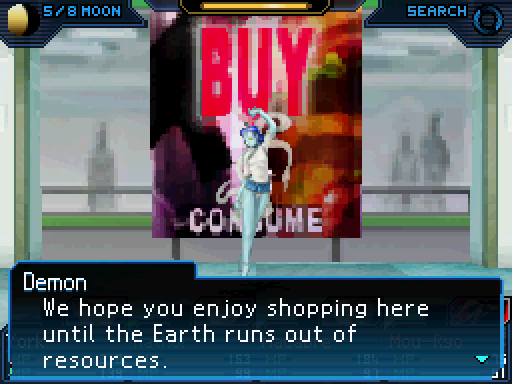
And you know what? It really creeped me out. Sadly, not entirely due to the game's aesthetics, but at least partially! Sector Carina was clever in being uncanny. At first look, everything does look like an ordinary shopping mall (through the filter of low-quality textures on a DS screen), but then you talk to the first NPC:


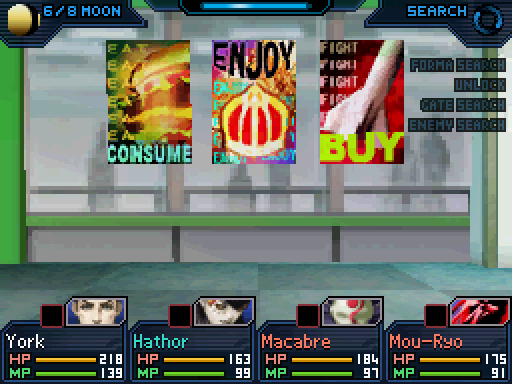
And then you look at the posters and the shop windows:


And then you pay attention to the slow, militaristic waltz used as background music:


And it settles in that this is a shopping mall with all of the pretence stripped away. Everything you could ever want is within these walls (along with a whole lot of stuff you don't), and your only company are towering urges to BUY, EAT, and CONSUME.

Relevance in a Riot

I was playing Strange Journey in August 2011, and reached Sector Carina during the time when the England Riots occurred. For those who aren't familiar, a riot broke out in Tottenham, a district of London, on the 7th of August. What had started out as a protest against police corruption and brutality in the area took a turn for the violent once someone decided to throw a bottle when the police arrived to suppress the protest. Things escalated quickly, with shops smashed and ransacked, and arson attempts. Once it started, similar riots sprang up all across London, and then into other, unrelated cities of England.


On the day they had started, I happened to already be in the centre of town, watching Croydon slowly go up in flames on BBC News. Had I not gone home when I did, the underground and bus services would have closed, leaving me stranded on Tottenham Court Road. I get home by sundown and find through Twitter that even my local high street had rioters.

While the area where I lived wasn't especially wealthy, it didn't have economic and police problems as severe as the ones in Tottenham. As I found out more about the event, it became woefully apparent that the majority of the rioters weren't causing anarchy for any kind of cause, other than their own pockets.

In a way, even though what happened is incredibly sad, I empathise. People riot in pursuit of aspirations, and ideally you'd want those aspirations to be political. However, many of us (and I'm including myself here) have aspirations that don't extend too far beyond our economic status, the next pair of shoes, the next luxury meal, the next tablet computer.

That some of us are willing to go to the lengths of destruction just to get it (along with the vague promise that you won't get caught) is actually pretty scary! It weighed on my mind, as I progressed through Carina, being told that the area was run by the demon Horkos, a glutton so dedicated, it ate an entire space craft, filled with the protagonist's comrades. Drawing a parallel between materialism and violence is heavy-handed, but it's not exactly incorrect.

It is later implied through some side-NPC dialogue that the layout of the Sector was based on a human shopping mall. This kind of M. Night Shyamalan twist made me roll my eyes, but then, the Westfield shopping mall in Stratford opened.

Retail Therapy & Theming Consistency


It's hardly likely to be the largest shopping complex out there, but I felt dwarfed by Westfield Stratford's size when I visited in its opening week. It had a casino. It had a 10-screen cinema. It had a food court that took up almost a third of the whole complex, with every kind of regional cooking speciality. It's the kind of place that would get anti-capitalists and anti-consumerists feeling violently ill, but I actually, honestly enjoy that kind of thing.

As I walk around, I recall Sector Carina and suddenly feel awkward. I make a realisation. For once, the moral soapboxing in a piece of media is about me. Funnily enough, by being very faithfully tied to the rules of what makes an Atlus JRPG, Strange Journey keeps its theme and its gameplay woefully separated. It hamstrings the entire game, really.

While I couldn't get emotionally invested with the themes of war or lust, if they'd taken the time to do something to make those ideas relevant to the player, they'd have more impact. It makes Sector Carina's effectiveness something of an accident. While the stage itself didn't do anything to make you think about greed via the game mechanics, materialistic greed is something that I can admit to having done in the past, way more than bloodthirstiness or careless environmental destruction or (sadly) wanton hedonism. Sector Carina was effective because the setting has (at least for me) some real-life parallels; not just a strawman argument of humanity.

While my experience with Strange Journey is very much down to circumstance, the aesthetic and theme of Sector Carina could still be used in other games. Commerce as Horror is something not really explored, unless you count Dead Rising (you shouldn't) or one of the stages in Illbleed (which does use greed as a mechanic, impressively). No one should experience their neighbourhood being torn apart in the pursuit of goods in real life, but they can damn sure could see it done in a game.

N.B.: You can read about the finer details of the 2011 riots at the Guardian here. The information is surprisingly extensive.

Thursday, 8 March 2012

Running from your relationships: Catherine review

This review can also be found at The Yorker, here.


Video games aren't too great at dealing with relationships; especially sexual ones. Often, when sex comes up in a game, it's as a 'reward'; and if the game is particularly immature, as a mini-game. In that light, Catherine, a game about relationship problems is refreshing. It's been a long time coming - Catherine saw a release in the US last summer (and in Japan earlier still), but has only just made it to UK shores.

I'm not just talking about some pastel-soft high-school love triangle, here. Catherineis about cheating, choosing between passion and responsibility, and dealing with the resulting nightmare one's life can become. Both figuratively and literally.


You play as Vincent Brooks - 32, with a dull day job and a small, slightly trashy apartment. He's been dating his girlfriend Katherine for years - but now she's starting to talk marriage, and Vincent isn't quite ready for that step. Drowning his sorrows at the Stray Sheep bar, he encounters Catherine, who has everything he wants in a woman, his dream girl. After a one night stand he doesn't remember; he is thrown into moral turmoil - how could he possibly tell Katherine about his infidelity? What's worse, nightmares about climbing collapsing towers while chased by twisted versions of his fears start haunting him every night...

The gameplay is starkly split between the dialogue-heavy trappings of a visual novel and a fast-paced action-puzzler. While on paper the two genres don't blend readily, in practice the two modes play off each other to keep things fresh.

Story segments at the Stray Sheep are compelling in seeing how the characters handle the idea that there's a curse that kills those who cheat, among other romantic ills and gender politics; but the nightmare stages break the calm by being tense and fast-paced - not to mention challenging on any difficulty other than Easy (and even then, Easy stops pulling punches halfway through). Then after a boss has bean defeated, you get to wind down the tension with the continuation of plot.

However, what I find most interesting is how the topic of sex and relationships is discussed as something entirely other than an ideal. While both Catherine and Katherine are physically attractive; they're both flawed people and put a lot of pressure on poor Vincent. Once both characters show their true colours, you feel just as worried as Vincent when the emotional and possibly physical stakes of having sex get much much higher.

The game wants you to seriously consider such dilemmas - to the point where after every Nightmare stage, Vincent has to sit in a confessional and be asked an either/or question on relationships before being whisked away to the next area. If you're connected to the internet, you answer is compared to the first-time answers of other players.

These choices along with others made in the story go towards a Law/Chaos meter (A variation on the good/evil choices in a lot of other games, but the semantic choice of using law and chaos is relevant); though sometimes it just feels as though it's a visual indicator of your allegiance with the two Catherines. Your alignment does affect certain lines of the story; but the actual ending (of which there are multiple) is decided largely independantly of this mechanic - a shame.

Aesthetically, Catherine is mostly in the positives - if you've played an Atlus RPG before (Most notablyPersona 4) you'll recognise the style of character design and the wonderful music by Shoji Meguro. What lets the side down is that the animation can be a bit stiff at times - all the attention to detail has been put into the facial expressions.


It's always refreshing for a high-budget game to be unabashedly unique; in an industry full of sequels; and as such, I'm ready to recommend it to most who are interested in games that do something different - but prepare yourself for nightmares of your own once the puzzle stages pull out the stops.

Monday, 27 July 2009

Who's Afraid of the Big Bad Dire Wolf?

Games have progressed a hell of a lot over time. That's something of an obvious statement when you look at the complex and powerful capabilities of the current-gen consoles compared to the Ataris and the Commadores of old, but the way we look at game design has changed also.

Due to a combination of limited graphics, sound, and memory, the earliest games couldn't show or tell you much. If a game was to have a plot, it was all told via text - usually in the instruction manual. As such, all early games had very simple objectives, and simple reasons for doing so. Why shoot the undulating blobs of pixels in Space Inavder? Because they're invaders! From Space! It's hardly the work of Dickens.

In a bit of nerd-culture overlap, tabletop RPGs (Dungeons and Dragons being the flag-bearer of the genre, to... mixed responses) were often used as examples for how early games with a limited ability to "show, not tell" could generate a game world for the player to experience. In Japan, this is the initial concept (along with the graphics push the Nintendo Entertainment System provided) behind both Dragon Quest and Final Fantasy, but before that there were games like Wizardry.

While Wizardry wasn't the first digitised Tabletop RPG (that would go to the 1980s game Rogue, a game represented entirely in ASCII, and shared a few similarities with the games at hand), it was definitely one of the most popular series of its time. Back then, Wizardry was famed for the way it was involved in the conception of a one-day extremely popular genre, creating many, many gameplay devices still used today. Now, Wizardry is immortalised for being SOUL CRUSHINGLY HARD.

This is just conjecture on my part, but I would wager that the difficulty of the Wizardry games (all 8 of them, with the 4th being especially ball-busting) was to extend the lifespan of the game. Not everyone can afford (or even want to) buy a game regularly, and having a game be rediculously hard is a very efficient if sadistic way of achieving that. The games boasted such wonders as missable items that're required to progress in the game; foes and traps that can kill you with little to no warning or respite (with your save game being deleted if you die); and even a hidden timer that will kill the player's party of adventuers of old age if you took too long to complete it.

Needless to say the series was a mega hit in Japan, to the point where a spin-off company started producing remakes and new games under the Wizardry name, actually outliving the American company. One of the hardest and most unfair games series in history had changed gaming forever.

But wait! The tale does not end there. Atlus (who I've mentoned before as one of the primary RPG publishers) recently released what can only be described as a love letter to the halcyon days of extremely difficult dungeon exploration. That love letter is The Dark Spire for the Nintendo DS. It's Wizardry in almost every sense of the word (Wizardry 2, if you want to get specific); right down to the way characters are created, the complex and very retro battle mechanics, and the Excuse Plot to rule them all (There's a tower with a wizard in it. He stole some royal jewelery, so go kick his ass! Who cares if he's actually doing anything with it!).
You know you're disrespected when even those suffering from Jaundice push you around...

However, they've gone to some lengths to modernise; and honestly, they'd have to. As old games were limited by their hardware; with no such limitations present, it'd be a total waste to not make use of them. The game has 2 'modes'. A 'Modern' mode with brooding, gothic graphics offset by a trippy neon colourscheme; and a 'classic' mode that drags things right back to their roots - The graphics become 8-bit and almost entirely monochrome. The impressive soundtrack also changes between full capability and 8-Bit chipsets, which continues to impress me. Every time I heard a new song, I switched the mode to classic to hear the retro version.
"But... we can't attack you hand-to-hand. We say attacks and numbers rise from your head."

Of course, the battles and the way the dungeon exploration works changed extremely little from the games it's birthed from; but that's not necessarily a good thing. While the sillier rules such as dying of old age are removed for the sanity of the masses - unfair fights and swift deaths still run rampant. Death of a party member is a very significant loss - reviving a dead character is extremely expensive; money is hard to come by, and you need every penny to be able to rest at the inn when needed. Poison traps are introduced as early as the tutorial dungeon, and will kill a character in seconds (you take damage for every 'step' you make in the dungeon) if not immediately treated.
All that treasure is worth a single Potion? FANTASY ECONOMICS~

While the first few floors do contain weak monsters to fight, the game will (at complete random) throw a significantly harder fight at you, usually as punishment for exploring (you seem to encounter stronger enemies more often when discovering new ground, rather than treading old areas). It's usually hard to run from these, and if you're caught off guard - such as when you're heading to the dungeon exit to heal up - the battles usually result in a swift game over. My favourite situation was in a fight against the 'Floating Coins' enemy. They have an attack that can hit all members of the party; but it only does 1 damage per person, often not doing damage at all. I initially laughed these off, until the game made me fight FIFTEEN of these at once. All of them using that attack, and coincidentally not failing to damage so much anymore...

Difficult battles you can eventually take in your stride, but what really bugged me about this game were the very complicated and obscure menu screens. The game will very happily give you starting items and equipment, but not tell you that it's not already equipped. You can't see the effectiveness of new items until you've bought them - and no, just because it's more expensive doesn't make it better. The most irritating thing of all is that one of the buttons will delete an item from your inventory with no insurance message - and by that same vein, will let you use an item on any character without any failsafes. This will lead to incredibly fustrating situations where you'll accidentally (and irreversibly) throw away that expensive mace you've just bought, or use your last antidote on a member that's not poisoned.

The game has a professional finish, but it belies extremely outdated gameplay. It's nice to be able to visit (or re-visit) a time where RPGs were presented in the rawest essence imaginable - and there's a rediculous amount of party customisation to be had with a brain-bendingly interwined experience/skill/magic/job system; but it always feels more than a little unfair - the game is very rarely on your side, and the effort you put into what you achieve is only passingly rewarded.

If you thought RPGs today are too easy, then by all means dig into this demon of a game. You're a stronger man than I. Pikachu and friends feel oh-so comforting.

Thursday, 12 March 2009

It's My RPG, and I'll Pout if I Want To


Role Playing Games (or RPGs) are known for two main concepts: firstly, they must contain teenagers with weaponry powerful enough to level a whole city; secondly, they make you do the same tasks over and over. These repetitive tasks (appropriately called 'grinding' by many) are the bread and butter for many games of this genre - an easy way to make a short game longer and more difficult. Unlike other game genres (racing games, shooters...) RPGs don't require much in the way of caffiene-fueled twitch reflexes, and grinding is the easy way out.

Don't misunderstand me here; the RPG is by far my most favourite genre, and it's rare to find a game that's completely ruined by the grinding, but this gameplay mechanic is so old and overused (the very first RPG videogame was Dragon Quest on the NES - the first Final Fantasy game actually came afterwards), that the game designers of today are practically pleaded with by their fans to do something a little different. And fortunately, they do. Occasionally. Several recent RPGs employ mechanics to alleviate the repetition (although the teenagers with heavy weaponry still remain). The World Ends With You for the Nintendo DS has a difficulty system you can change at any time - eliminating grinding completely, if you choose.

My World, My Way - produced by RPG giants Atlus, released for the DS - handles grinding just a little bit differently. Starring a spoiled princess-turned-adventurer (guess how old she is...), she overcomes difficult enemies and repetitive tasks by... moaning about them.

Having influence over the entire kingdom (and being continually watched by a mercenary hired by the King - the game tells you very quickly that the entire adventure is a ruse to placate the princess), she can 'Pout' at any time during her adventure to turn the tables in her favour; and there's a pout for pretty much anything. Monsters aren't dropping enough money or items? Pout for it. A locked treasure chest you can't find they key for? Moan about it until it opens itself for you. Just can't be bothered to collect 10 Demonic Explosive Potatoes? Whine enough, and the game will be happy enough to complete itself for you.

If only he knew...

A self-completing RPG would be a little too easy, so those who want a challenge may want to try and ignore Pouting completely, but the game will try its damn hardest to make you change your mind. By making quests so easy to complete with Pouting on your side, My World, My Way will turn the Grind-o-Meter all the way up to 11 should you even consider trying to restrain the temper tantrums. Assigned quests rapidly go from 'collect 5 things' to 'collect 25 things', with enemies increasingly stronger than you are (expect to survive the first few battles of a new area by the skin of your teeth). Every so often you'll encounter enemies that you have no hope of beating at your current level, and you'll ponder about using the 'Make Enemies Weaker' Pout, as your inner Gamer is reduced to tears.

This guy is pretty weak, but when you encounter a swarm of stronger ones...

Eventually, it becomes commonplace to ignore the story altogether for long stretches of time to gather money and items to spend on stat-boosting food and increasingly powerful weaponry, even if you do Pout often. There's a limit to how many times you can pout in one 'day', and you must return to town and rest before you can fight effectively again. And at that point - where you realise that Pouting is essentially a grinding wolf in sheep's clothing - that My World, My Way stops becoming fun.

The graphics and sound are up to a very high quality, and although the dialogue is a little vapid in places, it tries its hardest to poke fun at the common pitfalls in RPGs (the whole reason why the princess is on her adventure is to impress a Level 99 Paladin with a god complex), with fairly amusing results. But you'll see the same enemies a little too often, and hear the battle theme a few too many times, and what should have been a fresh experience ends up sweet, but stale - like a month-old chocolate bar.

You can tell she wants to do some grinding with him. In more ways than one.

My World, My Way is an honest attempt to be a different RPG, but it seems even veterans like Atlus can't resist Superhuman teenagers and super-boring busywork.