Sunday, 10 April 2011

Android's Dream - ASUS Eee Pads

This article has also been posted at The Yorker and the VG Resource.

With technology, new hardware is made to compete with old rivals. For example, it’s clear the similarity of the Playstation Move to the Wii Remote is no accident or coincidence. Similarly mobile phones were being influenced by the Blackberry and (later on) the iPhone. And now with the iPad, an era of Tablet Computers has come to public attention. Apple has the advantage of a high-profile and brand name, so other companies need to think of other methods to compete.


ASUS, the fairly prolific laptop and netbook producer, has jumped whole-heartedly into the tablet computer market with two different Eee Pad models, the Eee Slate and the Eee Pad Transformer.

The Eee Slate is the simpler of the two. A 12-inch screen and running Windows 7 Portable, it’s very much a downsized laptop – complete with USB Port and SD card reader. However, the Win7 Portable operating system (OS) isn’t a stunning one. The main reason why the iOS system (that powers both the iPhone and the iPad) is so popular is because of its ease of use, a design specifically to be used out and about. This OS is the ordinary Windows 7 with added touch-screen functionality. It feels slower and clunkier than just using a mouse, and the keyboard program is especially sluggish.

Fortunately, the Eee Pad Transformer deftly avoids these problems. Smaller and more lightweight – with only a 10-inch screen – the most notable feature is that it comes bundled with a detachable keyboard. It’s no larger than the tablet itself, but it’s where all the magic happens. It functions as a charging dock with all the ports and connectors you’d expect from a proper laptop. For someone like me who resents the cramped and unresponsive keyboard approximations that touch screen systems normally offer, this is a godsend.

The OS is the Android 3.0 Honeycomb, the latest of a system ordinarily used for mobile phones. Its design is a cleaner layout, and closer to the look of desktop Macs and PCs. This is bolstered with pre-installed software from ASUS. Software installed by a hardware company is often terrible – existing to slow down your computer and pelt you with advertising (Toshiba does this with their laptop range, and it’s a crime against humanity) but this appears to be a rare exception.

The most interesting app is Waveshare, an online storage program. Offering unlimited storage space for your music, movies and files for no cost in the first year, it’s a great offset for the Transformer’s limited memory (16 or 32GB); but there’s an (at time of writing) unknown monthly charge after that year. Freeloaders like me can use the free Dropbox app for Android as an alternative.

The other aspect of Waveshare is the ability to connect with any computer, monitor or projector that uses DLNA, allowing you to stream your media from your Transformer to the big screen, or through your sound system. Even cooler, you can set up your home computer to have Remote Access with it, so if you leave that presentation back at home, all is not lost. It’s a very decadent (and a little pretentious) approach to modern computing.

In an attempt to one-up the iPad’s weak notepad app, the Transformer comes with its own word processor, spreadsheet and presentation software. It’s incredibly bare bones, so while it’s a very good way to take notes or edit essays on the fly, you won’t want to write your dissertation on this thing. If you use Open Office to do your work, you’ll be sad to find these programs can’t read .odt files. Ouch.

The Eee Pad Transformer performs well as both an Android device and netbook. Considering its £429 price tag, it’s great value for the practical design and useful software, but it’s way beyond the average student budget – especially if you’re already rocking an iPad or Samsung Galaxy Tab.

By the time you read this, the ASUS Eee Tablet Transformer should be on sale (£429, £379 without the tablet). The Asus Eee Slate is already on sale online only (£999!).

Sunday, 3 April 2011

The Great Genre Expedition: Beat 'Em Ups

This feature has also been posted at The Yorker and the VG Resource.

Like any other media, the range of genres in video games is vast, and they don't get equal representation. Everyone is aware of the Pop/Rock section in record shops, the Crime section in book stores, and if games stores sorted their stock by genre, you'd find FPS and Brain Training games dominating the shelves. But other genres can't be ignored - there may be something that you never knew you liked.

Unless you grew up near an arcade in the 90s, the Beat 'em Up is one of those under-represented genres. The name is apt; you roam across a level, beating seven bells out of any thugs, monsters or robots that stand in your way, with a mean-looking and tricky boss at the end of each stage. Showing up mostly in arcades, many games offered addictive, but incredibly difficult game play, enticing you to put another coin in to keep going.


Between the comic books and the film, Scott Pilgrim has become a (self-professed) paragon of the 21st Century Nerd. So it makes sense that when a video game was made, it would be based on such a retro genre, complete with chunky, brightly-coloured pixel art, and music done by Chiptune/Rock band Anamanaguchi.


Playing as the series' four main characters, they fight through locations of the comic, to take on love interest Ramona's 7 Evil Exes. There's a lot of divergence from the original story, but that results in a level where you beat up overweight ninjas in a restaurant - so I'm fine with that. The game is easier than old-style beat 'em ups, but more involved. Your characters level up as they cave in the faces of hipsters and street thugs, gaining new moves and growing stronger as you progress. This makes later stages much easier; but much more accessible.

Scott Pilgrim Vs. The World is downloadable from Xbox Live Arcade and Playstation Network.


This is one of the more iconic games in Beat 'em Up's history. Released in 1993 for the Sega Mega Drive, it outshines its predecessor by introducing characters with more unique strengths and weaknesses, which has become a staple of the genre (and even influencing other genres) ever since.


By today's standards, the game is pretty difficult. There are a limited number of lives and continues, and once you lose them all, it's back to the start of the game for you. The bosses you face are challenging on first appearance - and then quickly become regular foes in later stages. Playing with a friend makes things easier and more entertaining, but be aware that you can attack your partner. Accidentally fitting them with a flying kick, or taking their health item when they're near death is how rivalries are born.

Streets of Rage 2 can be played on as part of Ultimate Sega Genesis Collection (PS3/360) or downloaded from the Wii's Virtual Console.


 There are a lot of bizarre arcade entries I could put here (The Simpsons beat 'em up comes to mind), but something about this game that wowed me, beyond the ridiculous name. Based on a comic book, the game reflects this by having over-the-top characters and action sequences. Losing a life is accompanied with an airstrike hitting everything around you - whether you're above ground or not. Dinosaurs roving the city fly into a rage, and are placated by punching them in the face. It's a great experience.


However, the game pulls no punches. Any of the four playable characters are capable fighters, so the game balances things out by giving them very little health. A game for those who enjoy taking on a challenge.

Cadillacs and Dinosaurs is an Arcade game, but can be emulated on your PC! Read up about it here.

Wednesday, 23 March 2011

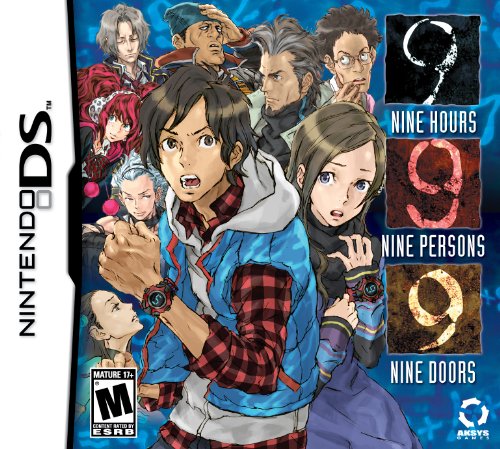
Death Count - 9 Hours, 9 Persons, 9 Doors

 
The genres for video games are vast. Most are aware of First Person Shooters. Real Time Strategy is less common but hardly unheard of. But then there's the Visual Novel; a genre only really paid attention to by a much more marginalised audience. They are what the name suggests - games that are interactive books - focusing on the story depth and characters rather than action sequences.
 
Games of this type vary in quality; the Ace Attorney series is the best example released in the West, but Japan has its own special sub-genre of risqué Visual Novels that creep me out.

9 Hours, 9 Persons, 9 Doors (herein referred to as 999 for my sanity) is very much its own beast. An easy way to describe it would be "The cast of Ace Attorney in a Saw film", but that doesn't quite do it justice. You play through the eyes of Junpei - a teenager who has woken up in an abandoned bedroom on a ship. The only thing in his possession is an irremovable metal bracelet with a '5' on it. Then inexplicably, the room starts to flood with water, and Junpei must find a way to unlock the door, or die trying. He finds that he and eight others are playing the 'Nonary Game', where success means escape, failure means drowning, and breaking the rules means a bomb in your stomach going off.

The game's puzzles all function similarly, each room you enter contains a set of puzzles resulting in an escape route unlocking. None of the tasks are straightforward, but they're all based in sensible leaps of logic, solved with patient thinking. So while there is a sense of atmosphere and tension in solving the puzzles (though there's no time limit), it's not frustrating - a lesson that the Professor Layton series could learn from.

With the puzzle sections so short, the bulk of 999 is instead taken up with narrative; and damn is there a lot of it. There can be hours worth of dialogue in between each interactive element, sometimes even within the room escape sections. This would be unbearable under most circumstances, but the story is strangely compelling. Of course, it doesn't exactly stand up to a quality ink-and-paper novel, but the subject matter and quality of the translation from Japanese is impressive. While there is no on-screen gore, descriptions of violence and of any 'rule breakers' you come across are done creepily well.


The character depth is what made the game for me. While the room puzzles are enjoyable, they're brief. This game survives entirely on the strength of its narrative; so thank goodness it's such a good one. In the early stages of the story, the characters feel like numbered narrative devices, but as you progress, all the characters become fleshed-out and empathetic; you'll definitely find a favourite. This is coupled with a quality soundtrack done by Shinji Hosoe, previously known for the high-octane techno tracks he creates; this is first foray into ambient and atmospheric tunes, and it works incredibly well.

999 has multiple endings, depending on which puzzle rooms you decide to tackle. Each ending explains more about the characters and nature of the Nonary Game, so repeat plays are necessary to understand everything. On subsequent runs, you're able to fast-forward through text that you've already seen; which makes the process much quicker - sitting through some of the longer cut scenes again would be maddening.

999 rewards the open-minded gamer. A game consisting of 'pulp novel' dialogue will be a huge turn-off for some, but the execution is so well done, I implore the adventurous to check it out. Be prepared to use an importing website, though - while the American release has been available for a few months, there is no sign of an EU release as of yet.

This review has also been hosted on The Yorker and can be found here.

Wednesday, 16 March 2011

Lupe Fiasco - Lasers


I'm a firm believer in giving new albums a chance. Maybe it's because there are enough annoyingly vocal people on the Internet yelling "This new album is different to the others so it SUCKS." Or maybe it's because I get funny looks from my friends when I say I like Muse's The Resistance as much as their earlier stuff. But I am compelled to keep an open mind when new tunes are released by the artists I like.

And I won't front in that regard; I love Lupe Fiasco. When I heard that his new album (and potentially final one, if his desire to only release his mixtape and 3 albums holds true) was in production, I decided to not spoil myself until it was released. I eventually caved, and listened to his single, 'The Show Goes On' and...
It was different, so I kind of hated it. And then felt bad for my sentiment. But no matter how I sliced it, the more 'top 40 rap song' beat wasn't what I looked for in Lupe, and it disappointed me. But on the other hand, it increased my hope that the album would be really varied in style.

As it turned out, that turned out to be exactly the truth. Lasers has been split neatly in two - almost to the degree where I'm starting wonder if it's intentional. The first half boasts almost all the musical tropes I can't stand: a male, boorish backing of "Oh oh ohs" on ‘Letting Go’, the flat, half-singing on ‘Till I Get There’ (though the lyrics for the verses are incredibly clever), and upon listening to a few forgettable others and getting to ‘Beautiful Lasers’, you're pelted with a full-on auto-tune chorus.

But then, ‘Coming Up’ happened. Leading in with a neat and simple piano riff, the beat dropped with a big helping of synth strings, and suddenly everything flashed back to early 2000s R&B. The sudden change was incredibly relieving, but my pessimistic side expected it to be a fluke. This was followed up with ‘State Run Radio’, which solidly proved me wrong. The cute radio-tuning sound effects and cheesy rock guitar melody made me think of a more mature-sounding Gym Class Heroes (that's not a bad thing, I promise).

‘BREAK THE CHAIN’ (capitalisation theirs) goes on a '90s club bent with a drum loop that almost made me fall out of my chair. Sway features as a guest rapper, and part of me was happy to know that the British lyricist hadn't entirely faded into obscurity.

‘Never Forget You’ and ‘Shining Down’ are somewhat weaker, not quite demonstrating the musical or lyrical style of the tracks preceding them; but ‘All Black Everything’ and ‘I'm Beamin’’ shine through as the best tracks on the album, delivering some incredible lines. They're great concepts; and exactly what I love about Lupe.

Lasers may be bifurcated in its musical quality, but Lupe Fiasco's rapping skills and meaningful lyrics definitely haven't dulled. And in time, I can grow to accept, maybe even enjoy the more mainstream first half. Though I'll never grow to like auto-tune. Jay-Z was pretty off in his predictions.


This article has also been hosted on The Yorker. You can find it here.

The Happiest Game on Earth - Kirby's Epic Yarn

Yes, I know the US got this game months before we did, but this is new and fresh to me at least!
The Kirby series has something of a reputation. The design has always been cute and endearing; and the game play undemanding, but fluid and enjoyable.

Over time, the games have varied in quality and difficulty, but we just can't hate the little guy, nor the games he appears in. Kirby's Epic Yarn doesn't buck that trend, but instead refines what makes Kirby games so charming and enjoyable, with a unique difference.

Everything is made from yarn. Or felt. Or cotton wool. Justified through a somewhat contrived plot line of Kirby being turned into yarn and whisked away to Patch Land by the wicked Yin Yarn (groan), the developers have gone wild with the art direction, and seamlessly blended it with how the game plays. The levels themselves scrunch up, unzip and unravel as Kirby progresses through each stage, accompanied by the angry looking Prince Fluff as a second player. Each stage is scored by the number of beads you collect, awarding bonuses for not taking damage and collecting items, with a bonus roulette of beads at the end. The score goes towards a ranking at the end of the stage.

Kirby's Epic Yarn is essentially one giant bedtime story - and that goes beyond the alternate interpretation of the game title. The pastel colour scheme, the light-hearted and whimsical concept and a soft spoken narrator for the cutscenes gives the entire package a feel like you're acting out the next Gruffalo or Very Hungry Caterpillar.


This stylistic choice seeps into the game play too. It's impossible to fail a stage in Epic Yarn. While all the staple platforming hazards are present and correct - enemies (adorably animated), crushing ceilings (denim constructed), rising lava (orange silk) - if Kirby collides with them, he'll reel back as his hard earned collectables go scattering. This means that Kirby's story will always end as intended; stages will be completed and bosses beaten. The effect of this is twofold - players who aren't much used to platformers will eventually finish their quest without much frustration, and more experienced gamers can pursue 'perfect runs' of each stage, racking up the highest scores.

As I played, I found that the game provided far more challenge than I had expected. Simply beating the game was a fun, but undemanding experience, so I felt compelled to try something that I almost never do with my games - a 100% completion. The check list of items heading to full completion was a lengthy one - unlocking all the stages, getting a Gold rank on every stage, collecting all the hidden items, beating the bonus challenge levels, filling in the encyclopedias of characters, enemies, and music tracks...

Playing the game in co-op feels like a much more rewarding experience than playing alone. Picking up your ally and throwing them up to new areas or into enemies can make some areas a lot more fluid; though you could argue it makes an already easy experience even easier. Then again, as both players can be damaged, some stages will rob you of all you hard-earned beads as Kirby and Prince Fluff get crushed, burned or battered. If there's a gap in skill between the two players, it can get a bit heated, as one player lags behind, or drops gems often. Go in with a relaxed attitude, or let the soothing piano soundtrack do it for you.

Kirby's Epic Yarn is a very different way of handing a 2D Platformer, but by no means a bad one. The experience may be too cheerful or too unchallenging for some; but hating this game is equivocal to hating fun. Fact.


This article has also been hosted at The Yorker, and can be found here.

Monday, 7 March 2011

Let's Build a Computer!

Note: This article has been hosted at The Yorker in two parts. This version is edited to be a full piece, and be less specific to the Societies and shops in York. This version has also been mirrored on the VG Resource's blog. Check it out!


Computers are complicated. For the most part, there's a general assumption that building your own computer, especially one designed for gaming, is a task that can only be performed by the Computer Science students with a huge budget (or those who don't mind spending their student loan). In a way, that's true – a lot of self-professed 'PC Gamers' spend a lot of money on their rig - but I knew that building my own machine would save me a lot of money compared to going to the nearest PC World or Currys and being given an overpriced machine with added bells and whistles that I neither wanted nor needed.
So with my Christmas, birthday, and part-time job money saved up, I took to the Internet to shop for parts. This was by far the most complicated part of the process. While I had an idea of what parts I needed (a motherboard would be obvious, a power supply unit incredibly necessary), what specifications and what brand gave a ridiculous number of options. Looking at the UK computer sales sites Scan.co.uk and Aria.co.uk, they had an uncanny knack of not letting me compare different items for cost or performance. Against all personal standards, I would have killed for a computer nerd equivalent of Go Compare.
In the end, I found a website dedicated to building computers that gave clear indicators of what items I would need to put together a cost effective machine. It didn't take long to search for those, and result in the following:

(In addition to this, necessary accessories like a monitor, a wireless adaptor, and a keyboard and mouse.)
Factoring in delivery costs, the total of it all came to £411.

Waiting eagerly over the weekend, the parts finally arrived in two separate deliveries. The disadvantage to shopping from multiple sites was my goods not all arriving at once. A bit skittish about going into building my computer entirely blind, I nagged my housemate doing a Computer Science degree to help me out.
As it turned out, there wasn't much that I couldn't do solo. While all the parts were from different companies, the instructions that came with them all were simple to understand, and didn't conflict with each other; everything fitting into place with screws, wires plugged in with satisfying clicks. Following each instruction correctly with no problems gives a slight feeling of pride and achievement; as if I was building an IKEA flat-pack bookshelf, but one I could play video games on.
About an hour later, I had finished. Hooking up the monitor and keyboard, it all turned on just fine. And then I realised.

I didn't buy a DVD drive! How on earth was I supposed to install my copy of Windows without one? My progress was put on hold as I made another trip to Scan:


The DVD drive arrived the next Tuesday, and I excitedly wired it up to my machine. Like before, plugging in all the cables was a snap, but another problem arose; it was just a few millimetres too big to fit into the computer case. This was less of an issue; once Windows was installed and my computer was up and running, I disconnected the DVD drive, and everything still ran smoothly.

The final step was to buy a graphics card. Without one, playing any recent games on my computer would be a huge struggle for the motherboard's weedy integrated graphics - definitely not what I'd want. The high-end Graphics Cards are incredibly expensive, the biggest and best going for almost £300 a pop and are as large as a DS Lite. That was definitely not the kind of money I was looking to spend; so I turned to second-hand sales. It didn't take me long to find an American selling his old PC parts:


The card arrived faster than expected, but there was one final issue. Computer monitors can use multiple types of connection plugs, the two common ones being the blue VGA, and the white DVI. The graphics card had a DVI socket, but my monitor had a VGA cable. Fortunately, this problem was both simple and inexpensive to fix – there are adaptors that can convert a plug from VGA to DVI. Currys was threatening to charge me £21 for this relatively simple lump of metal and plastic, but checking out an independent computer hardware store, I was able to get an adaptor for just £4.

Fitting in the graphics card and using the new monitor connection was the final step, and a huge relief. The computer searched for and installed the correct drivers with minimal fuss, and a little tinkering and testing to make sure everything was working the way it should, my £460-odd project was complete. The specifications were undemanding – not a patch on the really high-end gaming machines, but the ability to run Borderlands without the slowdown and choppy frame rate my laptop offered made me sigh with satisfaction. Mission complete.

Want to build your own PC? Here are a few hints:
  • Don't be put off by the technobabble. While all of the numbers and codes will be useful to some people, try and focus on the basics. If it's RAM or a Hard Drive, what's the memory size? Are the case and motherboard size compatible? Is your processor designed for your motherboard? All this information should be easy to find.
  • Look everywhere! I purchased most of my parts from big retailers, but looking on eBay, trading websites, or even asking your friends for their old PC they keep in the attic might yield useful bits and pieces.
  • Be Prepared to Build! While the actual building phase can be straightforward if you're good at following instructions; having a second pair of hands will make referring to instructions and getting the pieces ready a lot faster. Don't be a loner! It's also a good idea to have your own screwdrivers and cable ties to hand, the parts don't always come with them.
  • Measure, measure, measure! While most computer parts are built to a standard size, and should fit perfectly into your case, there's still a chance something might be build to an odd size. Double check the measurements just in case something might not fit snugly. You can make alterations by yourself if need be, but not recommended. If something snaps in half, don't say I didn't warn you.

Tuesday, 22 February 2011

So Now, You're a Crossing Gate: Ghost Trick


When video games as a general rule have the player character avoiding death (or inflicting it); it's an unusual thing when a game starts with the Player Character dead from the get-go. You play as Sissel, a reawakened amnesiac spirit in a junkyard accompanied by only a red-suited corpse, a female detective with a bizarre hairdo, and a blue-skinned assassin in a suit, hefting a large golden shotgun. The detective seems to know something about how and why you died, but meets an untimely death. Fortunately you gain the power of the 'Ghost Trick'; the ability to possess and manipulate small objects, and the ability to rewind time to the 4 minutes before someone else's death. If you can save the detective, maybe you'll get some clues about your past...
 
Ghost Trick was directed by Shu Takumi, the same director behind the Ace Attorney series, and by God that legacy shines through in this work. That series was packed to the brim with over-the-top memorable characters, great storytelling, and an episodic feel that made it easy to pick-up and play. These design philosophies have been expertly transported into Ghost Trick; Sissel's musings are sarcastic and likeable, Detective Lynne is still worth rescuing every time she meets her end (even after the gunman in the junkyard, she has troubles staying alive), and storyline chapters are just the right length for you to finish one on the train, or before you go to bed.

However, the Ace Attorney series has stagnated over time. The initial three DS releases are actually re-released Japanese-only Game Boy Advance games - and replaying them now, the age shows a little. The more recent games rely mostly on the success of - and cameos from - the previous instalments; and while I am pretty damn excited for Ace Attorney Investigations 2, it won't offer anything in the way of a fresh experience. Ghost Trick is that breath of fresh air, both in terms of how it looks and how it plays.

Game play reminds me of a Rube Goldberg Machine. When rewinding someone's death, you have to manipulate items scattered around the room to alter the path of those in peril. A victim can't hear the assassin approaching due her headphones? Knock them into the nearby fish tank. Large wrecking ball suspended by a fragile clamp? Get the clamp to open, and watch havoc unfold. If you spend too long, or accidentally put the victim in even more danger, you can go back to the start of the 4 minutes at any time, with no penalty. The puzzles are logical and encourage you to tinker around with the pieces for happy successes, and the occasional hilarious failure.

The style of the game is also extremely noteworthy. Where Ace Attorney mostly used mugshots and still images to tell its story, Ghost Trick is an animated wonder. Stylised 3D models waltz across the 2D set with a whole lot of energy and flair. For character Detective Cabanela, just walking downstairs or answering the phone can be turned into a performance. The design of the locations has the gritty Film Noir aesthetic, but rendered in bold colours and anachronistic technology. The same goes for the funky soundtrack - mysterious grooves with an electronic flair.

The story is a gripping one, but it's filled with so many twists, I'd feel bad for sharing it and spoiling the experience. The ending is open enough to have a sequel if Capcom wants more money; and in a way they're fully justified. Ghost Trick is a total gem of a game, and is one of the best Story-Driven puzzlers on the DS to date. And that's no Trick.

A demo of Ghost Trick can be played for free online here! Awesome!


 This article has been hosted on The Yorker, and can be found here.

Thursday, 17 February 2011

IT CAME FROM OUTER SPACE: Dead Space 2


I'll admit now that I don't have much patience for the Shooter genre. Both of the first and third person varieties. I've not indulged in many horror games either. So this makes me playing Dead Space 2 a bit of an odd match up. While I had played the first Dead Space, it honestly didn't grab me. Its polish and quality was clear as day, but I just wasn't hooked by its premise.

Dead Space 2, on the other hand, is a mutation of its predecessor. The basics are the same - surviving endless waves of alien parasites popping from air vents and broom cupboards - but Dead Space 2's tone of delivery is different. Very different. Where the prequel prided itself on a silent, creepy atmosphere with a muted palette, protagonist and soundtrack - this game is all about loud, bold action and goofy set pieces; something I enjoy, but struggle to take seriously.

The game opens with protagonist Isaac in a straight jacket, being half-cared for, half-captured by a group looking into the nature of the aliens he'd splattered in the first game. Right on cue, one of these aliens bursts into the scene, violently violates the medic monitoring Isaac, and the player is directed to flee for his life. Restrained by the jacket and with no armour or weapons, Isaac's escape should be a very harrowing experience; but his goofy movement animations, his stomp attack that's heavy enough to shake the screen, and the multiple cut scenes where other survivors are mutilated by aliens while Isaac remains oblivious or just plain uncaring evokes memories of MadWorld, not Silent Hill.

The locations you run through also give an aura of cliché B-Movie horror, relocated to a space station. Take a setting, and add a dramatic "In space!" to the end, and watch it appear in Isaac's jaunt aboard The Sprawl.
Abandoned hospital, in space!
Blood-stained elementary school, IN SPACE!
Ominous church with added foggy graveyard IN SPAAAAAAAACE!

Facetiousness aside, this tone for Dead Space might prove to be a bit of a problem, not because the game isn't taking itself seriously; but because despite the game's pitch-black humour, it still wants to evoke a sense of atmosphere and drama. The decision to give Isaac dialogue and occasional scenes where he's haunted by hallucinations of his dead girlfriend doesn't so much make him human and tormented, but foul-mouthed and cardboard flat. The game tries time and again to get me to care about Isaac, but I'm too busy watching the awesome death cut scenes to notice (Watch Isaac have his arms rather unrealistically removed by an air-lock door without making a Monty Python Black Knight reference. I dare you). The game pulls a page out of Bioshock's book and leaves small video and text files lying around, but they're either unhelpful or uninteresting to read. Isaac's tour of the space station is well-detailed but so incredibly linear, the scare-factor of having to deal with enemies is diminished when you notice that the doors lock behind you whenever there's something in the room you need to tear apart.

So who would I recommend the game to? Fans of the first, definitely. There is a lot of polish to the flow of the game that outshines the original, and most likely other 3rd Person Shooters floating around. But if you're looking for a haunting, atmospheric experience; you're unlikely to find it here. Stomping on corpses to get at the ammo and money hidden within, and flying around with rocket boots is however, a more than satisfying replacement.

This article has been hosted on The Yorker, and can be found here.

Tuesday, 15 February 2011

What I learned from working at GAME

I now write for The Yorker, a new media site. You can find the original publish of this article here.

Being a student with a pressing need to pay for rent, groceries, and alcohol, I was pumped to get a job working at a GAME over the winter holidays. Initially it felt great to earn my own money - rather than it being supplied by my parents or the government - but as I worked there, what I learned changed by views on games retail slightly.

1) The market is a lot smaller than I thought. If I want to buy a game online, I have tons of options. Not just eBay and Amazon, but 'digital distribution' systems like Steam, where purchased games are directly downloaded to your computer, no plastic boxes or shipping. High street shopping is a different beast, however. Dedicated games shops will stock a wider range of content than HMV or Tesco, but the success of online shopping has downsized dedicated games retail. Many independent shops have closed, leaving GAME, Gamestation, and CEX the last 3 competing chains. But interestingly, GAME and Gamestation are actually owned by the same company. In fact, every so often we got extra stock of second-hand games from them when we were running low. The pricing and trade-in values are the exact same, too. You have to wonder why they're even separate shops.

2) Game Charts are a bit of a sham. Nearly any store that sells games will have a set of shelves devoted to the 'top games' out at the moment; just like books and CDs. However, while the charts of CDs are heavily monitored, games are less so. The means that in most GAMEs, the charts will be a top list of the games the shop wants to shift or promote, more than what's actually selling. This will result in the new, big-name releases always being in the #1 spot, and terrible games that they want to offload not being that far behind. I don't believe that Hello Kitty: Birthday Adventures is the #3 game at the moment, do you?

3) Customers can be really... weird. The best example I've experienced was one gentleman who came in to trade in a large stack of old Xbox 360 games to trade against a Kinect. Unfortunately the games weren't worth very much, and he was pretty ticked to find out that I could only give him about £37 for his troubles. He then decides to not bother getting a Kinect, and picks up various new games from the shelves - waiting until no one's looking, and leaving the shop with them. The catch? For security reasons, we don't put the games inside the display boxes on the shop floor - he fled the premises with nothing more than a collection of empty boxes, leaving his old 360 games behind in the process.

4) The 'Big Name' releases aren't the best sellers. I was employed during a number of the big Winter releases - Medal of Honor, Call of Duty: Black Ops, Fable 3... but none of them sold in particularly huge numbers. At a guess, I wager that it's down to a mixture of them being available to purchase online, and the target audience for those games coming into the store less and less. The biggest sellers were budget DS games (I've sold more copies of Peppa Pig: Fun and Games and Imagine: Animal Doctor than I can remember), and a bizarre subset of PC games that revolve around 'find the hidden object' game play. If I ever get in to games design, I'm going to make a hidden object game about sick ponies. I'll make a killing.

Saturday, 29 January 2011

Your Article Has Performed an Illegal Operation

I had fun doing this one. Self-Parody is clearly the best parody. However, I feel like I need more practice at photomanipulation now...